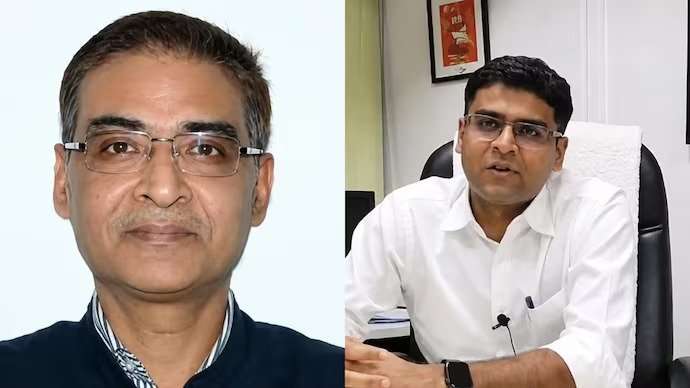
CBSE Chairman and Secretary Transferred Amid Growing On-Screen Marking Controversy
The Central Board of Secondary Education (CBSE) is facing mounting scrutiny over its newly introduced On-Screen Marking System (OSM), with the government transferring Chairman Rahul Singh and Secretary Himanshu Gupta amid allegations of serious irregularities in the evaluation process and questions surrounding the awarding of the digital assessment contract.
The decision comes at a sensitive time as the CBSE continues the process of declaring examination results while grappling with criticism from students, parents, parliamentarians and cybersecurity experts.
One-Member Panel Ordered to Investigate Tender Process
In a parallel development, the government has constituted a one-member inquiry committee to investigate the procurement and implementation of the On-Screen Marking system.
The committee will be headed by S. Radha Chauhan, Chairperson of the Capacity Building Commission, and has been tasked with examining the tendering process and related concerns.
The panel has been directed to submit its report to the Department of Personnel and Training (DoPT) within one month.
The move signals the seriousness with which the government is treating the allegations surrounding the project, which was intended to modernise the evaluation of board examination answer sheets.
Students Report Answer Sheet Mix-Ups and Evaluation Errors
The controversy erupted after numerous students reported discrepancies while accessing scanned copies of their answer sheets.
Several students who sought digital copies discovered that the documents uploaded on the portal did not belong to them.
The issue triggered widespread concern over the integrity of the evaluation process.
CBSE officials have acknowledged that around 20 cases of answer-sheet mismatches were identified during the assessment process.
Apart from answer sheet mix-ups, complaints have also surfaced regarding evaluation errors, faulty checking procedures and incorrect grade allocations.
The incidents have raised questions about the reliability of the new digital evaluation system and its implementation at scale.
Cybersecurity Experts Flag Technical Issues
The OSM platform has also come under criticism from cybersecurity experts and students who highlighted multiple technical shortcomings.
Users reported payment failures, missing answer sheet pages and severely blurred scanned copies that made verification difficult.
Concerns were also raised about potential security vulnerabilities in the evaluation portal and the handling of student data.
In response, the CBSE recently launched a dedicated portal aimed at addressing cybersecurity concerns associated with the OnMark platform operated by its service provider.
On Sunday, the board announced that cybersecurity specialists from various government agencies and Indian Institutes of Technology (IITs) had been deployed to strengthen the platform’s security infrastructure.
The portal is expected to remain operational until June 6, 2026.
How the Tender Controversy Began
At the centre of the controversy is the contract awarded for the Digital Scanning and On-Screen Evaluation system.
The CBSE had selected Hyderabad-based Coempt Edu Teck to manage the scanning and digital evaluation of lakhs of answer sheets.
However, scrutiny intensified after documents related to the tender process revealed significant differences between the original tender conditions and the final contract signed with the vendor.
According to documents reviewed from the procurement process, the original tender floated on August 28, 2025, contained strong enforcement provisions.
The initial framework empowered a CBSE committee to recommend blacklisting the vendor, forfeiting the Performance Bank Guarantee (PBG) and terminating the contract in the event of serious violations.
Final Contract Removed Blacklisting Provision
Critics have pointed to major changes in the final six-page agreement signed with the vendor.
While the contract retained provisions for financial penalties and contract termination, the blacklisting clause was reportedly removed.
Under the final agreement, the vendor could face a penalty of Rs 1 lakh for every 15-minute delay in resolving critical issues flagged by CBSE.
An additional penalty of Rs 1 lakh could be imposed for every 60-minute delay in submitting a root-cause analysis and corrective action plan.
The contract also permits forfeiture of security deposits and termination in severe cases.
However, the absence of a blacklisting provision has become a key focus of the ongoing inquiry and political criticism.
Political Storm Reaches Parliament
The issue has now escalated into a political controversy after being raised in Parliament.
Leader of Opposition Rahul Gandhi and several other Opposition leaders have accused the CBSE and the government of serious lapses, citing allegations of blurred answer sheets, mobile phone-based scanning methods and concerns over student data security.
The Parliamentary Standing Committee on Education subsequently summoned CBSE officials and the Education Secretary to explain the reported evaluation discrepancies and concerns over high re-evaluation fees.
Student Testifies Before Parliamentary Panel
Adding further momentum to the controversy, 17-year-old student Sarthak Sidhant from Jharkhand appeared before a parliamentary panel on Monday to present concerns regarding the OSM project.
According to reports, the student highlighted alleged anomalies in the tendering process used to select vendors and raised a series of questions regarding the implementation and oversight of the system.
His presentation before lawmakers has drawn significant attention and added to calls for greater transparency in the board’s digital evaluation reforms.
Pressure Mounts on CBSE
The transfer of the CBSE’s top two officials and the launch of a formal inquiry represent the most significant administrative response so far to the controversy.
As the investigation progresses, attention is expected to focus on whether procedural lapses occurred during procurement, whether adequate safeguards were in place during implementation and how affected students will be compensated if evaluation errors are confirmed.
With millions of students relying on CBSE examinations for higher education admissions and future career opportunities, the outcome of the inquiry is likely to have far-reaching implications for the board’s credibility and its ongoing digital transformation initiatives.