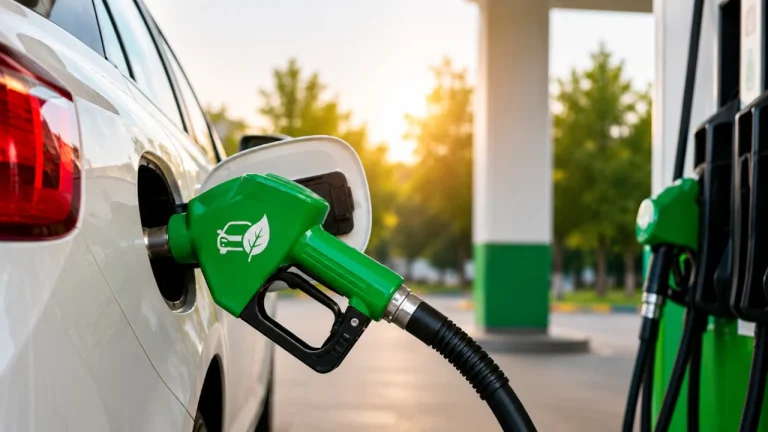
In a significant expansion of India’s fuel diversification roadmap, the Centre has formally notified new standards for higher ethanol-blended petrol variants, including E22, E25, E27 and E30 fuels, marking the next phase of the country’s ethanol blending programme.
The new specifications were issued by the Bureau of Indian Standards through a notification dated May 15 under the standard IS 19850:2026. The framework covers “E22, E25, E27 and E30 Fuel, Admixture of Anhydrous Ethanol and Motor Gasoline for Usage in Positive Ignition Engine Powered Vehicles.”
The notified categories refer to petrol blended with 22%, 25%, 27% and 30% ethanol concentrations respectively.
India Expands Ethanol Blending Strategy Beyond E20
The latest move signals a major policy push by the government as India attempts to reduce its heavy dependence on imported crude oil amid continuing uncertainty in global energy markets.
At present, India imports more than 85% of its crude oil requirements, making fuel diversification a strategic priority for policymakers.
The government has consistently argued that higher ethanol blending can help reduce the country’s oil import bill, support the agricultural economy and lower vehicular emissions.
The new BIS standards now create a regulatory framework for ethanol blends beyond the currently targeted E20 fuel, which contains 20% ethanol mixed with petrol.
E20 Rollout Accelerated Ahead Of Original Timeline
India had earlier advanced its nationwide E20 blending target from 2030 to the ethanol supply year 2025-26 as part of its aggressive clean fuel transition strategy.
Public sector oil marketing companies have already been scaling up ethanol procurement and distribution infrastructure across the country.
According to data released earlier this year by the Ministry of Petroleum and Natural Gas, India has already crossed the 18% ethanol blending mark at the national level.
The Centre had officially launched E20 fuel at select retail fuel outlets in 2023, following which automobile manufacturers began introducing E20-compatible vehicles across different categories.
What The New Standards Mean
The BIS notification provides detailed technical specifications for higher ethanol fuel blends that may eventually be introduced commercially in phases.
However, the government has not yet announced a timeline for the rollout of E22, E25, E27 or E30 fuels at petrol pumps.
Officials have previously indicated that the adoption of higher ethanol blends would depend on several factors, including:
- Vehicle compatibility
- Fuel distribution infrastructure
- Ethanol production capacity
- Supply chain preparedness
- Automotive industry readiness
The development also indicates that India may gradually move towards even higher ethanol-based fuels such as E85 in the future, similar to flex-fuel systems used in countries like Brazil.
Why Ethanol Blending Matters For India
The ethanol blending programme has emerged as one of the government’s most important long-term energy security initiatives.
Apart from reducing crude oil imports, ethanol blending is also intended to:
- Increase income opportunities for sugarcane farmers
- Reduce carbon emissions from vehicles
- Promote domestic biofuel production
- Improve energy self-reliance
- Lower foreign exchange outflows on oil imports
Most of India’s ethanol supply currently comes from sugarcane-based feedstock, though the government has also encouraged grain-based ethanol production to diversify supply sources.
Auto Industry Preparing For Higher Blends
Automobile manufacturers have already begun adapting engines and fuel systems to support higher ethanol concentrations.
Several companies have launched E20-compatible vehicles, while flex-fuel engine development is also underway for future adoption.
Industry experts believe higher ethanol blends may eventually require further engine modifications, fuel-line upgrades and calibration changes, especially for older vehicles not originally designed for higher ethanol content.