
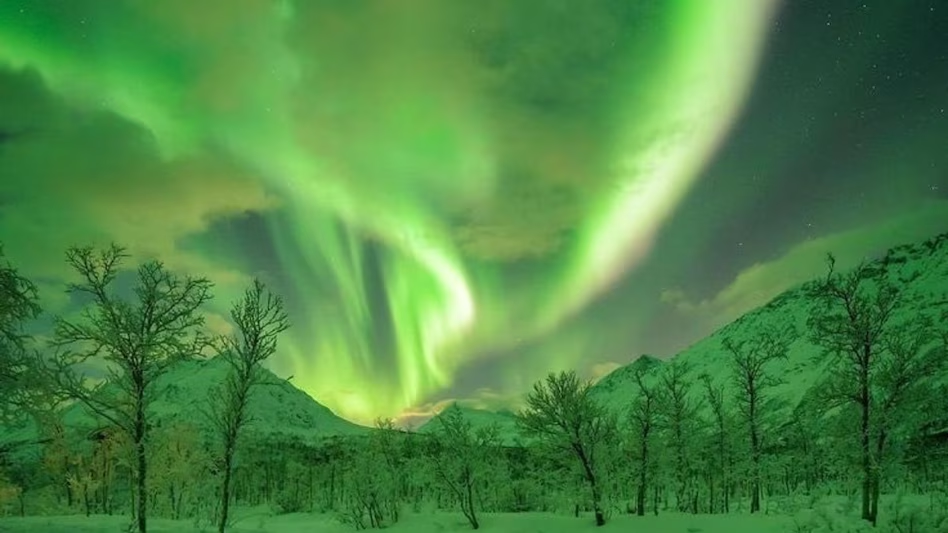


Skywatchers may be in for a rare celestial treat as a powerful solar storm heads toward Earth. Scientists say the event could trigger spectacular auroral displays, giving some regions a chance to witness the famous Aurora Borealis, or Northern Lights, far beyond their usual polar locations.
A massive eruption from the Sun has sent a fast-moving coronal mass ejection (CME) toward Earth, prompting space weather agencies to issue alerts. The geomagnetic storm is expected to reach Earth between June 8 and June 9, potentially creating vivid auroras across several parts of the world.
What Is Causing the Solar Storm?
The event began when the Sun released a large burst of charged particles and magnetic energy into space. As this cloud of solar material approaches Earth, it is expected to interact with our planet’s magnetic field, producing a geomagnetic storm.
Scientists have classified the event as a G3-level geomagnetic storm, which is considered strong enough to generate auroras at lower latitudes than usual.
What Are the Northern Lights?
The Aurora Borealis, commonly known as the Northern Lights, is one of nature’s most breathtaking phenomena. These colourful displays appear as shimmering curtains, waves, and ribbons of light dancing across the night sky.
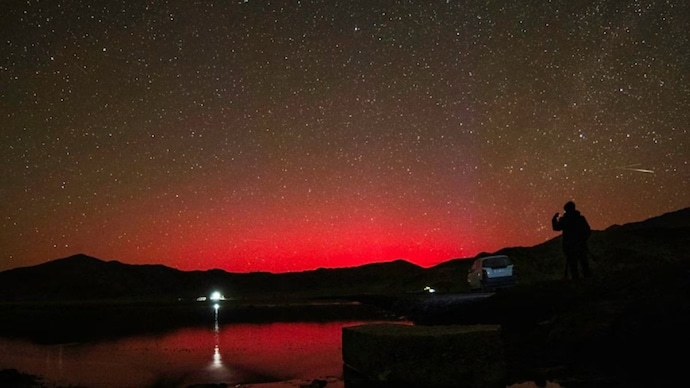
Auroras are typically seen near Earth’s polar regions and can glow in shades of green, pink, purple, red, and blue.
How Do Auroras Form?
Auroras occur when charged particles from the Sun collide with gases in Earth’s upper atmosphere.
As these particles interact with oxygen and nitrogen atoms, they release energy in the form of light. Different gases create different colours:
- Oxygen produces green and red lights.
- Nitrogen creates blue and purple shades.
The result is a spectacular display that appears to ripple and dance across the sky.
Could India See the Northern Lights?
While auroras are usually limited to high-latitude regions, strong solar storms can occasionally push the auroral zone much farther south.
In India, the best chances of observing the phenomenon are expected in high-altitude northern regions, particularly in:
- Hanle
- Ladakh
- Other elevated and dark-sky locations in the Himalayan region
Hanle has already gained attention for rare auroral sightings in recent months. The region is home to the Indian Astronomical Observatory, one of the world’s highest observatories, known for its exceptionally clear and dark skies.
Best Conditions for Viewing
Experts say visibility will depend on several factors, including:
- Cloud-free skies
- Low light pollution
- Strong geomagnetic activity
- Clear weather conditions
Those hoping to witness the phenomenon should move away from city lights and look toward the northern horizon after sunset.
A Rare Opportunity for Sky Enthusiasts
Although sightings in India remain uncommon, strong solar storms have occasionally produced auroral displays visible much farther south than usual. With increased solar activity currently underway, astronomers and stargazers are closely monitoring the skies for what could become one of the most memorable celestial events of the year.
For many observers, this may be a rare chance to witness one of nature’s most spectacular light shows without travelling to the Arctic.