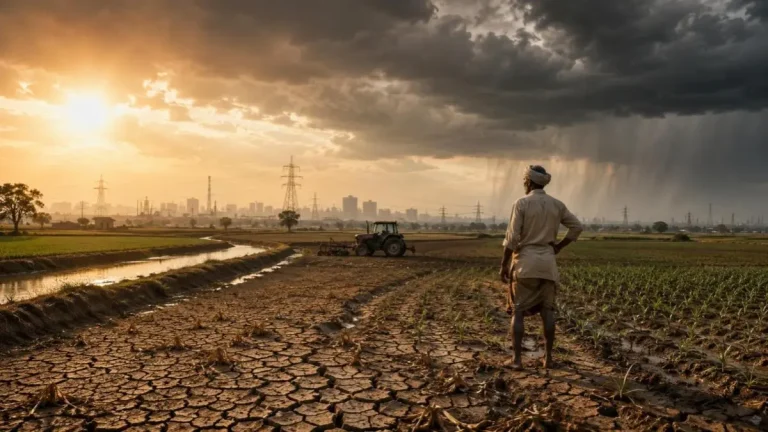
India is on course to record its third driest June in the last 100 years, with the country witnessing a sharp 42% rainfall deficit as the month draws to a close.
The unusually weak start to the southwest monsoon has raised concerns among farmers, water resource managers and urban authorities, with meteorologists attributing the poor rainfall primarily to the impact of a strengthening El Niño weather pattern.
According to rainfall data, the shortfall has affected every major region of the country, making this one of the most widespread June monsoon failures in recent decades.
India Records 42% Rainfall Deficit In June
The country has received only 92.2 mm of rainfall so far this month, compared to the normal 157.7 mm for June.
Even if widespread rainfall is recorded on the final day of the month, total June precipitation is expected to finish at around 100 mm, still well below the long-term average.
If that happens, June 2026 will become the third driest June since 1927.
Over the past century, only two years have recorded lower June rainfall:
- 2009: 87.5 mm
- 2014: 92.1 mm
Both of those years also witnessed severe monsoon deficiencies.
Rainfall Deficit Hits Every Region
Unlike many previous weak monsoon years, the rainfall shortage is not confined to one part of the country.
According to available data, all four broad geographical regions have recorded significant rainfall deficits.
- Central India: 54% deficit
- East and Northeast India: 41% deficit
- Northwest India: 30% deficit
- South India: 28% deficit
Meteorologists say such widespread deficits across all regions simultaneously are unusual and indicate that El Niño has already begun influencing India’s monsoon circulation.
What Is El Niño And Why Does It Affect India’s Monsoon?
El Niño is a naturally occurring climate phenomenon characterised by the warming of sea surface temperatures in the central and eastern Pacific Ocean.
This warming alters global wind patterns and atmospheric circulation, often weakening India’s southwest monsoon.
Since nearly 70% of India’s annual rainfall comes during the southwest monsoon season, any disruption has significant consequences for agriculture, water availability and reservoir levels.
According to the India Meteorological Department (IMD), the 2026 monsoon is now expected to deliver around 90% of the long-period average (LPA), placing it in the below-normal category.
The IMD’s latest seasonal outlook estimates:
- 60% probability of a deficient monsoon
- 84% probability of below-normal or deficient rainfall overall
Delayed Onset Added To The Weak Start
The southwest monsoon arrived over Kerala on June 4, three days later than its normal onset date of June 1.
After its arrival, the monsoon made only limited progress before stalling across large parts of the country, contributing to the significant June rainfall deficit.
Weather experts say the delayed onset, coupled with the strengthening El Niño, has prevented the monsoon from gaining its usual momentum during the month.
Will Rainfall Improve In July?
There are early signs of improvement.
According to IMD forecasts, the first week of July is expected to bring more widespread and better-distributed rainfall, particularly across Central India, which has experienced the largest rainfall shortfall in June.
However, forecasters remain cautious.
Several weather agencies expect below-normal rainfall to continue through much of July, even if rainfall activity improves temporarily.
As a result, the eventual success of the 2026 southwest monsoon will largely depend on how quickly rainfall revives over the coming weeks.
For now, the weak start has placed India on track for one of its driest Junes in a century, underscoring the growing influence of global climate patterns on the country’s most critical rainy season.