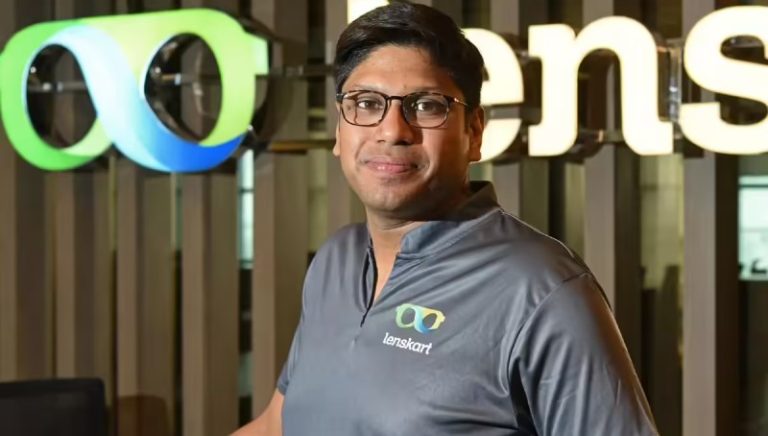
Lenskart founder Peyush Bansal took to social media on Wednesday, April 15, 2026, to address a growing controversy involving the company’s employee grooming policies. The backlash began after a document titled “Lenskart Staff Uniform and Grooming Guide” was leaked online, leading to accusations of religious discrimination against Hindu employees.
The “Viral” Guidelines
The document, which critics claim was issued as recently as February 2026, contained specific instructions regarding religious attire and markers for store staff:
Permitted: Black-colored hijabs and black turbans were explicitly allowed as part of the uniform.
Banned: The guide stated, “Religious tikka/tilak and Bindi/Sticker is not allowed.” It also prohibited visible religious threads (kalawa) and multiple religious rings.
Burkha Policy: The guide noted that while hijabs were allowed, wearing a burkha in the store was prohibited.
Bansal’s Clarification: “Language Lapse”
In a series of posts on X (formerly Twitter), Bansal dismissed the circulating document as an “outdated” or “inaccurate” version that does not reflect Lenskart’s current stance.
“Our policy has no restrictions on any form of religious expression, including bindi and tilak… An older version of our grooming policy had language that didn’t reflect our values. When it came to my notice in Feb this year, we got it fixed immediately.” — Peyush Bansal
Bansal took personal responsibility for the “lapse in language,” stating he should have caught the discrepancy sooner. He emphasized that the company’s intent was never to discriminate and that Lenskart employees across India are encouraged to “wear their faith and culture proudly.”
Public Skepticism and the “February 2026” Claim
Despite the apology, social media users and activists—most notably Shefali Vaidya—have challenged Bansal’s “outdated” defense.
Timeline Conflict: Users pointed out that the document in question is timestamped February 2, 2026, calling into question how a policy from just two months ago could be considered “outdated” without the release of a newer, corrected version.
Demands for Transparency: Critics are calling on Lenskart to make the current 2026 grooming policy public to prove that the restrictions on bindis and tilaks have indeed been removed.
Parity Concerns: Many argued that a “neutral” grooming policy should either ban all religious markers for professional uniformity or allow them all equally.
Context: The “Corporate Jihad” Narrative
The controversy has gained additional momentum as it follows a similar row involving TCS in Nashik, where allegations of religious coercion and harassment led to several arrests. The proximity of these two incidents has heightened public scrutiny regarding how large Indian corporations manage religious diversity and workplace “secularism.”