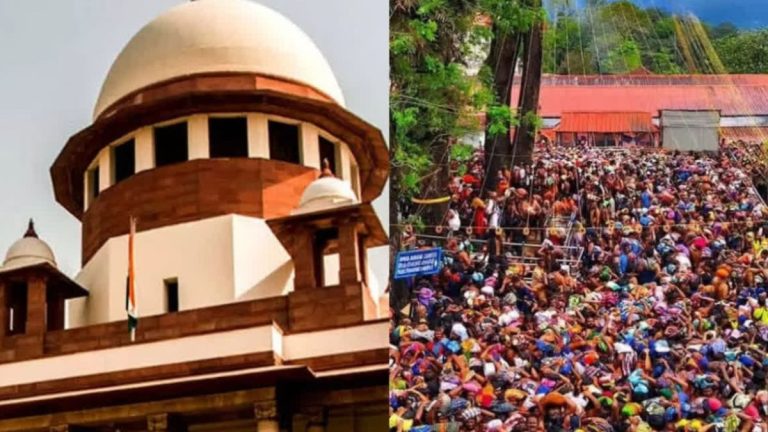
The Supreme Court raised concerns over the “essential religious practices” doctrine while reserving judgment in the Sabarimala
May 14, 2026: A nine-judge bench of the Supreme Court of India on Thursday questioned the continued centrality of the “essential religious practices” (ERP) doctrine while hearing the long-pending Sabarimala verdict reference case. During the concluding hearing, the bench observed that the doctrine could become “elitist” by privileging some religious practices over others. After 16 days of extensive hearings, the Constitution bench led by Surya Kant reserved its judgment in the matter.
The hearings evolved into a broader constitutional debate on religious freedom, judicial review, equality and denominational rights. Senior advocate K Parameshwar criticised the ERP doctrine, arguing that it effectively ranks religious practices and lacks direct constitutional basis. Justice MM Sundresh remarked that the doctrine also tends to be “elitist,” while Justice BV Nagarathna suggested it should be treated only as an aid to distinguish religious practices from secular ones rather than as a decisive constitutional test.
Several senior lawyers debated the balance between faith and constitutional rights during the proceedings. Tushar Mehta argued for limited judicial intervention in matters of religion, while advocates such as Abhishek Manu Singhvi, Rajeev Dhavan and Indira Jaising raised concerns over courts becoming arbiters of theology or failing to protect equality and dignity. The case traces back to the 2018 ruling that allowed women of menstruating age to enter the Sabarimala Sree Ayyappa Temple, overturning a centuries-old restriction.