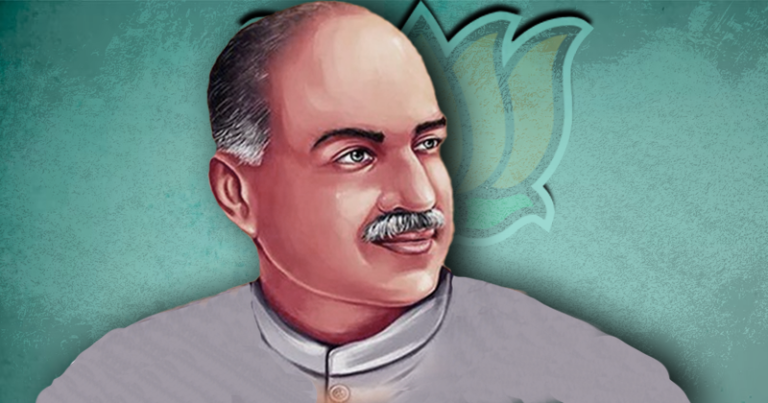
In the hallways of modern Indian power, the name Dr. Syama Prasad Mookerjee resonates as more than just a historical figure; he is the ideological North Star of the Bharatiya Janata Party (BJP). As the founder of the Bharatiya Jana Sangh (BJS), Mookerjee laid the groundwork for a political philosophy that challenged the post-independence status quo and reshaped the trajectory of Indian nationalism.
A Man of Many Facets: Educationist and Reformer
Before he was a political firebrand, Mookerjee was a scholar of immense repute. At the age of only 33, he became the youngest Vice-Chancellor of the University of Calcutta, following in the footsteps of his father, the legendary Sir Ashutosh Mukherjee. His early career was defined by a commitment to educational reform and the preservation of Indian heritage, long before he entered the stormy waters of national politics.
The Great Divergence: Leaving the Nehru Cabinet
Mookerjee’s transition to the opposition was a watershed moment in Indian history. Initially serving as the Minister for Industry and Supply in Jawaharlal Nehru’s first cabinet, he resigned in 1950 in a principled protest against the Liaquat-Nehru Pact. Mookerjee believed the pact failed to protect the rights of Hindus in East Pakistan (now Bangladesh), marking his definitive break from the Congress’s approach to secularism and minority rights.
Birth of the Bharatiya Jana Sangh (1951)
With the support of the Rashtriya Swayamsevak Sangh (RSS), Mookerjee founded the Bharatiya Jana Sangh in October 1951. It was established as a right-wing alternative to the Congress, built on the pillars of:
- National Unity: A fierce opposition to the special status of Jammu and Kashmir.
- Cultural Nationalism: The promotion of an Indian identity rooted in its ancient heritage.
- Uniformity: Advocacy for a Uniform Civil Code.
The Martyrdom in Kashmir
Mookerjee’s most enduring legacy is his crusade against Article 370. His slogan, “Ek desh mein do vidhan, do pradhan aur do nishan nahi chalenge” (One country cannot have two constitutions, two prime ministers, and two flags), became the rallying cry for the Jana Sangh.
In 1953, he was arrested while entering Jammu and Kashmir without a permit—a requirement he deliberately defied to assert that the state was an integral part of India. He died in custody in Srinagar under circumstances that many of his followers, including current BJP leaders, still describe as “martyrdom.”
Legacy: From BJS to BJP
Though the Jana Sangh eventually merged into the Janata Party in 1977 and later re-emerged as the Bharatiya Janata Party (BJP) in 1980, Mookerjee’s DNA remains at the core of the party’s mission. The 2019 abrogation of Article 370 was viewed by the BJP as the ultimate fulfillment of Mookerjee’s vision and sacrifice.