
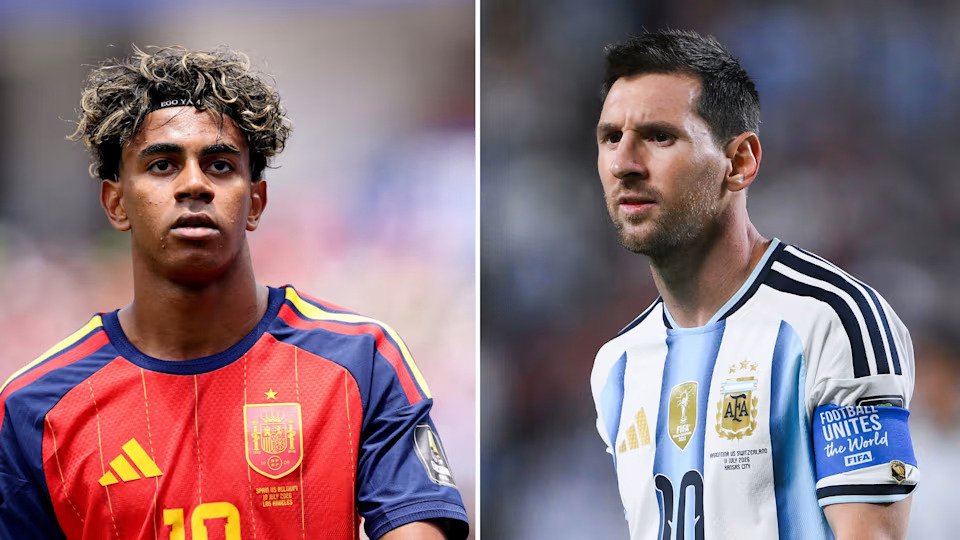


After more than a month of thrilling football, the FIFA World Cup 2026 has reached its grand finale. Defending champions Argentina and European powerhouse Spain are set to battle for the title on Monday in New Jersey, bringing the curtain down on the first-ever 48-team World Cup.
For Lionel Messi, the final represents another defining chapter in an extraordinary international career. At 39, the Argentina captain is preparing to play in his third FIFA World Cup final during his record sixth appearance at the tournament.
As Messi chases a second consecutive World Cup title with Argentina, an old story has once again captured the attention of football fans—how the legendary forward once had the opportunity to play for Spain but chose to remain loyal to his homeland.
Messi’s Journey Began at Barcelona, But His Heart Belonged to Argentina
Messi arrived in Barcelona in September 2001 at the age of just 13 after joining the club’s famous La Masia academy. Over the next two decades, he established himself as one of the greatest footballers in history, spending 21 years with the Catalan giants before leaving for Paris Saint-Germain in 2021.
Despite growing up in Spain and building his legendary club career there, Messi never wavered in his desire to represent Argentina at international level.
Marcelo Bielsa First Learned About Messi Through a VHS Tape
Former Argentina head coach Jose Pekerman, who later handed Messi his senior international debut, revealed that Argentina first became aware of the teenage sensation during the early 2000s.
In 2002, then-Argentina coach Marcelo Bielsa and assistant Claudio Vivas were visiting Spain to meet Argentine internationals when they received information about a highly talented youngster at Barcelona.
Messi’s former representative Horacio Gaggioli recalled how the now-famous VHS tape eventually reached Bielsa.
“That was [Messi’s dad] Jorge’s idea. He told me: ‘Horacio, the Argentine national team is coming to Barcelona, can you get them some footage of Leo?’ Leo wasn’t well known in Argentina. We had a video that I was given by Barca with some plays, and I went to the Hotel Princesa Sofia in Barcelona where they were staying. I asked for Vivas, who was Bielsa’s assistant,” Gaggioli told ESPN, as quoted by Hindustan Times.
He further explained how Bielsa reacted after watching the footage.
“When Marcelo renewed his contract with Argentina, we toured Europe to explain to the players why we had renewed after the South Korea-Japan World Cup (in 2002). During that stop in Barcelona, an Argentine man approached me.”
“I told Marcelo about him and he asked: ‘Does he play well?’ I said: ‘He doesn’t just play well, he’s incredible!’ ‘Let me see, play a little bit of it,’ Marcelo said, adding as I played the tape: ‘But play it at normal speed, you can’t see anything like this.’ I said: ‘Marcelo, it is at normal speed, I just pressed play.’ He said: ‘But this kid is unbelievable!'”
Argentina Nearly Missed the Chance to Secure Messi
Although Argentina’s coaching staff quickly recognised Messi’s immense talent, the country’s youth setup almost missed the opportunity to integrate him into the national team.
By the time the footage reached youth coach Hugo Tocalli, preparations for the 2003 FIFA U-17 World Cup were already well underway. Tocalli decided not to alter his squad, leaving Messi out of the tournament.
Argentina eventually suffered a 3-2 semi-final defeat to Spain, after which a member of Spain’s coaching staff reportedly told Tocalli that Argentina would likely have won had Messi played.
Spain Tried to Convince Messi to Switch Allegiance
Following the tournament, Argentina moved swiftly to bring Messi into its youth setup by organising a friendly match to assess him. Due to the urgency of arranging the fixture, an Argentine referee was even appointed to satisfy FIFA’s requirements.
Meanwhile, Spain also intensified efforts to persuade the young prodigy to represent them internationally.
Gaggioli revealed that interest from the Spanish Football Federation was significant.
“I received many calls asking whether he could play for the Spanish national team,” Gaggioli recalled. “I would tell them that the decision ultimately rested with Leo and his family. There was no question about his ability, but he had to choose.”
Messi Never Considered Playing for Anyone Except Argentina
Despite Spain’s interest and the opportunities available after spending most of his footballing life in Barcelona, Messi’s decision never changed.
According to Gaggioli, the eight-time Ballon d’Or winner always dreamed of wearing Argentina’s famous blue-and-white jersey while continuing his club career in Spain.
That decision eventually transformed football history, with Messi leading Argentina to Copa América glory before lifting the FIFA World Cup and cementing his place among the greatest players the sport has ever seen.
Now, as fate would have it, Messi will lead Argentina into the FIFA World Cup 2026 final against Spain—the very nation he once had the chance to represent—adding another remarkable chapter to one of football’s greatest stories.