
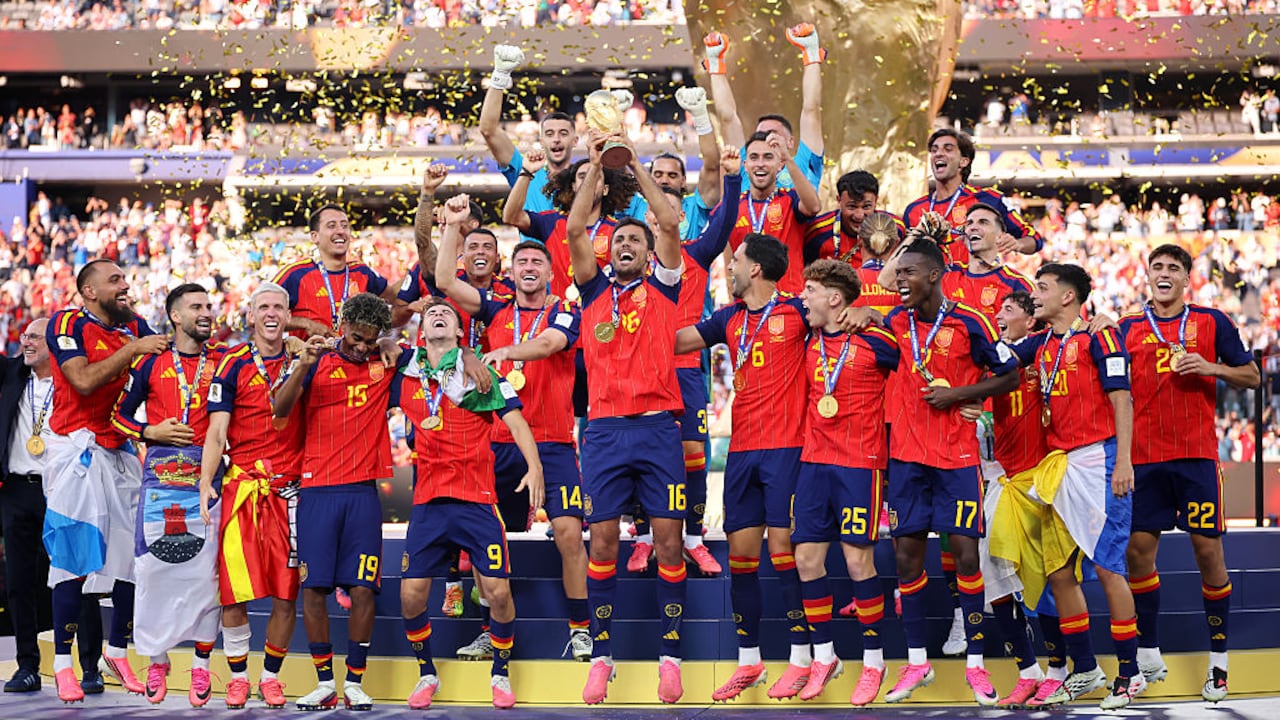


Spain were crowned FIFA World Cup 2026 champions after defeating defending champions Argentina 1-0 in a thrilling final that went into extra time at MetLife Stadium on Sunday.
Substitute Ferran Torres scored the decisive goal in the 106th minute, helping Spain secure their second World Cup title. Their first triumph came in 2010 when they defeated the Netherlands in South Africa.
The victory also ended Argentina’s reign as world champions after an intense battle that lasted 120 minutes.
Ferran Torres Delivers the Decisive Moment
The match remained goalless throughout normal time despite Spain creating several clear chances.
However, Spain finally broke the deadlock early in the second half of extra time.
Pedro Porro floated a cross into the penalty area, and Nico Williams headed the ball back across goal. Ferran Torres arrived unmarked inside the six-yard box and fired a left-footed volley past goalkeeper Emiliano Martinez in the 106th minute.
The goal proved enough to separate the two sides and hand Spain the biggest prize in international football.
Spain Controlled the Final From Start to Finish
Spain dominated possession for most of the contest and constantly threatened Argentina’s defence.
Luis de la Fuente’s side created numerous scoring opportunities, but Emiliano Martinez produced an outstanding performance to keep Argentina in the match.
The Argentine goalkeeper denied Lamine Yamal inside the opening five minutes before making excellent saves against Mikel Oyarzabal and Dani Olmo.
His finest moment came during stoppage time in normal time when he brilliantly tipped away Yamal’s curling free-kick that appeared destined for the top corner.
That save forced the match into extra time.
Argentina Suffer Injury and Red Card Blow
Argentina’s problems began shortly before halftime when central defender Lisandro Martinez was forced off due to injury.
He was replaced by experienced defender Nicolas Otamendi.
The defending champions faced another major setback in stoppage time of normal time when Enzo Fernandez received his second yellow card for a late challenge.
The dismissal reduced Argentina to 10 men, forcing Lionel Scaloni’s side to play the entire extra-time period with one player less.
VAR Cancels Spain’s First Goal
Spain believed they had taken the lead early in extra time when Nico Williams bundled the ball into the net.
However, the celebrations were cut short after the Video Assistant Referee (VAR) reviewed the move.
Officials ruled that Mikel Merino had fouled Otamendi during the build-up, and the goal was disallowed.
Spain eventually found the breakthrough just minutes later through Torres.
Argentina Failed to Test Spain’s Goalkeeper
Argentina struggled to create attacking opportunities throughout the match.
The defending champions did not register a single shot during the first 90 minutes.
They finished the entire 120-minute contest with only two attempts, and neither tested Spain goalkeeper Unai Simon.
Lionel Messi’s long-range strike in the 117th minute, which was blocked by Mikel Merino, became Argentina’s first shot of the final.
In the closing moments, Pau Cubarsi produced a crucial clearance from Giuliano Simeone’s dangerous low cross to protect Spain’s narrow lead.
Spain’s Dominance Reflected in Match Statistics
The final statistics highlighted Spain’s complete control over the match.
La Roja finished with 20 shots, including 11 on target, while Argentina managed only two attempts throughout the contest.
Spain consistently attacked from the opening whistle and created several quality chances before finally breaking Argentina’s resistance in extra time.
Their disciplined defensive display also ensured Argentina never seriously threatened an equaliser.
With this victory, Spain lifted the FIFA World Cup trophy for the second time in their history and added another historic chapter to one of the country’s greatest football generations.