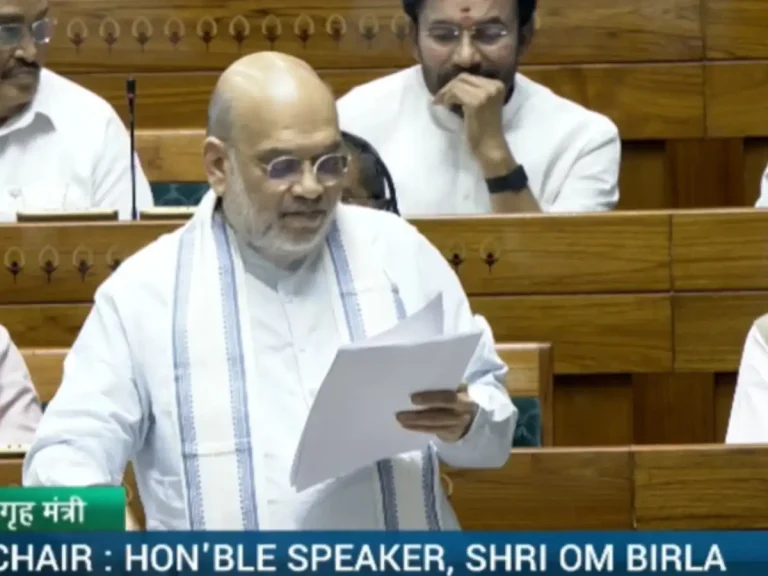
New Delhi: Union Home Minister Amit Shah on Friday strongly defended the proposed delimitation exercise, accusing opposition parties of opposing women’s reservation and the expansion of seats for Scheduled Castes (SC) and Scheduled Tribes (ST).
Replying to a two-day debate in the Lok Sabha on three key bills — including amendments to the women’s quota law and the formation of a delimitation commission — Shah said the exercise is necessary to ensure fair voter representation across constituencies.
He argued that delimitation would rationalise the number of voters per constituency, pointing out that some parliamentary seats currently have nearly 40 lakh voters, leading to unequal representation.
‘One Person, One Vote’ Principle Under Strain
Shah emphasised that large variations in voter numbers across constituencies undermine the constitutional principle of “one person, one vote, one value.”
According to him, there are currently 127 constituencies with more than 20 lakh voters, with some having as many as 45 lakh voters, while others have only around six lakh voters.
“As a result, the value of each vote is not equal across constituencies,” Shah said, stressing that delimitation would address these disparities.
Opposition Accused of Blocking Women’s Reservation
The Home Minister alleged that opposition parties had indirectly opposed the women’s reservation bill despite publicly welcoming it.
“If anyone hears this discussion carefully, one will realise that nobody openly opposed the constitutional amendment for women’s reservation. Everyone said ‘we welcome this move’. But all the members of the INDIA group clearly opposed women’s reservation,” Shah said.
He added that opposition resistance to delimitation also amounts to opposing an increase in SC and ST seats, as the Constitution mandates that these seats be revised in proportion to population growth.
Delimitation Linked to Women’s Reservation Implementation
Shah explained that the government introduced the current bills to implement provisions of the Nari Shakti Vandan Adhiniyam, which provides for women’s reservation in legislatures.
He noted that women’s reservation will be implemented only after the next delimitation exercise conducted following the post-2026 census.
He also referred to historical decisions, stating that constituency boundaries were frozen during the tenure of former Prime Minister Indira Gandhi in 1971.
“We did not freeze the number of seats. That decision was taken earlier. Only after lifting that freeze can the Nari Shakti Vandan Adhiniyam be implemented,” Shah said.
Caste Census to Continue Alongside Population Census
Addressing concerns that the amendment could delay caste enumeration, Shah clarified that the government had already approved caste enumeration alongside the national census.
“A Union Cabinet meeting in 2025 decided to carry out caste enumeration along with the census, and the process has already begun,” he said.
Offer of 50% Seat Increase If Opposition Supports Bill
In a significant political statement, Shah said the government is prepared to introduce an official amendment guaranteeing a 50% increase in Lok Sabha seats across states, provided opposition parties support the women’s reservation bill.
“The women’s reservation amendment bill will fall flat if the opposition does not vote in its favour. But women of the country are watching who the obstacle is,” he said.
Three Key Bills Under Discussion
The debate focused on three major legislative proposals:
- Constitution (131st Amendment) Bill
- Delimitation Bill
- Union Territories Laws (Amendment) Bill
Shah reiterated that constitutional amendments require approval by a two-thirds majority of members present in the House, and acknowledged that the ruling alliance currently lacks sufficient numbers to pass the bill without opposition support.