
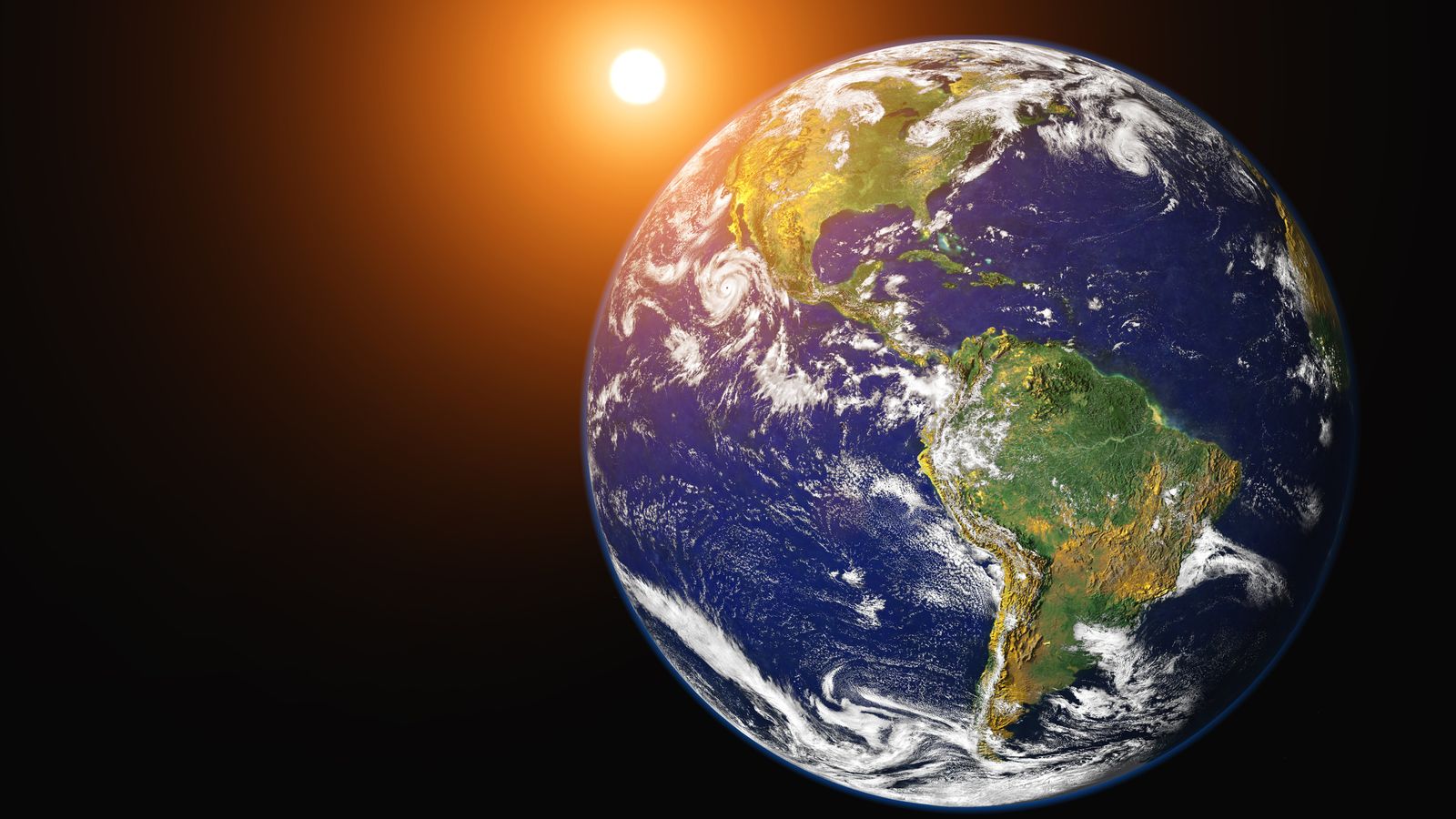


A new scientific study has revealed that climate change is not only warming the planet but is also gradually affecting the length of Earth’s days. Researchers have found that melting glaciers and polar ice sheets are slowing down the planet’s rotation, causing days to become slightly longer over time.
Although the change is extremely small — measured in fractions of a millisecond — scientists say the underlying forces are enormous and unlike anything observed in the past 3.6 million years.
According to the study, the current rate at which Earth’s rotation is slowing has become “unprecedented” in recent geological history.
Researchers explained that as global temperatures rise, massive ice sheets and glaciers near the poles continue to melt. The meltwater then flows into the oceans and spreads towards the equator. This redistribution of Earth’s mass affects the planet’s spin, much like a figure skater slows down by stretching out their arms while rotating.
Scientists have long known that Earth’s rotation naturally changes over time due to factors such as the Moon’s gravitational pull, movements inside the Earth’s core, and shifts in atmospheric circulation. However, researchers now say that climate change has become strong enough to rival these natural forces.
The study was conducted by scientists from the University of Vienna and ETH Zurich, who analysed geological evidence to determine whether similar changes had occurred in the distant past.
To investigate Earth’s ancient rotation patterns, researchers examined fossilised remains of microscopic marine organisms called benthic foraminifera. These organisms preserve chemical signatures in their shells that provide clues about ancient sea levels and climate conditions.
By studying these records, scientists were able to estimate how Earth’s rotation changed over millions of years.
The team also used a specially designed machine-learning algorithm to deal with uncertainties in extremely old geological data. This allowed them to study records dating back to the Late Pliocene period, around 3.6 million years ago.
The findings showed that today’s climate-driven slowdown in Earth’s rotation stands out sharply compared to historical patterns.
Scientists estimate that the length of a day is currently increasing by around 1.33 milliseconds per century. While the number may appear insignificant, researchers stressed that the mass movement involved is enormous.
Professor Benedikt Soja of ETH Zurich, one of the study’s co-authors, explained the scale by saying it would be equivalent to moving around 1,000 gigatonnes of mass from the poles into the oceans.
To put this into perspective, he said people could imagine a giant cube of ice towering nearly 10 kilometres above New York City — taller than Mount Everest.
Dr Mostafa Kiani Shahvandi from the University of Vienna, who led the study, added that the shift in Earth’s rotational energy is comparable to the energy released during a magnitude 9.0 earthquake, though not in terms of destruction.
The researchers identified one similar period nearly two million years ago when Earth’s rotation slowed at a comparable pace. According to scientists, that event was linked to large-scale melting of polar ice sheets caused by naturally rising carbon dioxide levels.
The study also warns that if greenhouse gas emissions continue to rise and fossil fuel use remains high, climate change could become the dominant factor influencing Earth’s rotation by the end of this century.
While the impact on everyday life remains negligible for now, scientists say the findings highlight how deeply climate change is altering even the most fundamental processes of the planet.