
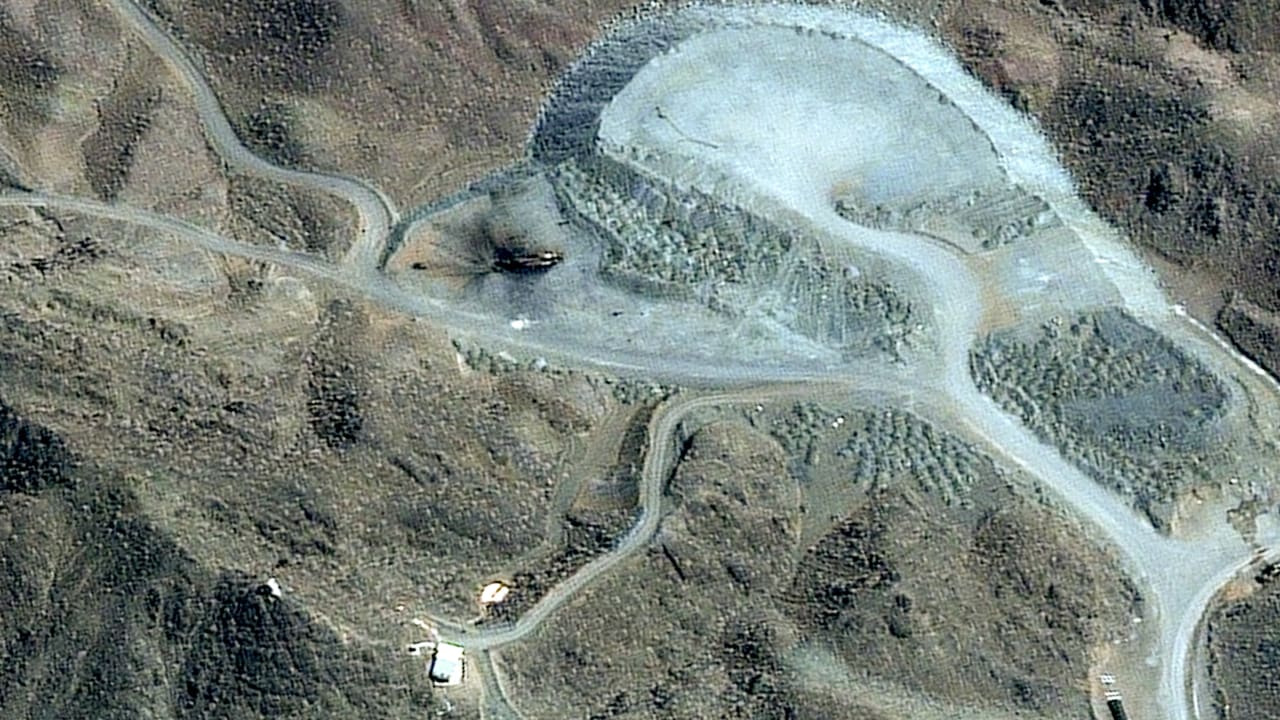


Iran has reportedly transferred thousands of nuclear centrifuges to a heavily fortified underground complex near Natanz known as Pickaxe Mountain, a move that could significantly complicate any future military efforts to target the country’s nuclear infrastructure.
According to a Wall Street Journal report citing US and Israeli officials, Israeli intelligence believes the relocation took place last autumn, several months after the 12-day conflict in June 2025 during which US and Israeli forces carried out coordinated strikes on multiple Iranian nuclear facilities.
Unlike other nuclear sites that came under attack, the Pickaxe Mountain complex was not targeted during those operations. It has also remained untouched since a broader aerial campaign against Iranian-linked sites reportedly began on February 28.
Underground Facility Buried More Than 300 Feet Beneath Granite
The Pickaxe Mountain complex is believed to be buried more than 300 feet beneath solid granite, making it considerably deeper and more heavily protected than Iran’s enrichment facilities at Natanz and Fordo, both of which were bombed during the 2025 military campaign.
The report states that the site’s extreme depth and natural geological protection would make it far more resistant to conventional bunker-busting weapons and airstrikes.
Satellite imagery reviewed by intelligence agencies reportedly shows sustained construction work and truck movements around the mountain over the past 15 months, indicating the facility has undergone continuous expansion and development.
Officials have not confirmed the origin of the centrifuges now believed to be housed at the site, though intelligence assessments suggest they may have been relocated from other Iranian nuclear installations.
IAEA Still Unable to Inspect the Pickaxe Site
The underground complex has remained beyond the reach of international nuclear inspectors.
Iran has not granted the International Atomic Energy Agency (IAEA) access to the Pickaxe facility and has provided little information regarding the activities taking place inside.
IAEA Director General Rafael Grossi said in March that Iranian authorities had informed the agency as early as 2021 of their intention “to have nuclear activity” at the Pickaxe location.
However, the absence of inspections and limited transparency have intensified international concerns that sensitive nuclear work could be taking place without independent verification.
The inability to monitor the site has become a growing source of concern for Western governments and global nuclear watchdogs.
Trump Signals Possible Military Action Against Pickaxe Facility
US President Donald Trump has repeatedly suggested that the underground complex could become a future military target.
Last week, Trump said:
“Pickaxe is a possible target for a nice big fat shot right near the front door,”
adding that the United States would “probably give Pickaxe a shot relatively soon.”
Speaking to reporters again on Tuesday, Trump further escalated his rhetoric, saying the United States would strike the location where Iran’s centrifuges are believed to be stored “pretty soon” and “very heavily,” while asserting that Tehran would be unable to prevent such an attack.
Former US Official Warns of ‘Worst-Case Scenario’
Nate Swanson, who previously served as the US National Security Council’s director for Iran during the Biden administration, described the reported developments as deeply troubling.
“A covert breakout is the worst-case scenario,” he said, referring to the possibility that Iran could secretly produce a nuclear weapon.
He added:
“We don’t know what Iran’s intentions are, but the fact that we can’t verify this site underscores how problematic the status quo is.”
His comments reflect growing concerns among Western security officials over the possibility that nuclear activities could continue beyond the reach of international oversight.
Iran Continues to Reject Nuclear Weapons Allegations
Iran has consistently denied pursuing nuclear weapons, maintaining that its nuclear programme is intended exclusively for peaceful civilian purposes, including energy production and scientific research.
However, Tehran has enriched uranium to levels just below weapons-grade purity, a development that experts say has little practical civilian application and has repeatedly raised concerns among Western governments, the IAEA, and international non-proliferation experts.
With reports of advanced centrifuges now housed in one of Iran’s most heavily fortified underground facilities, questions are likely to intensify over the future of nuclear inspections, regional security, and the possibility of renewed military confrontation.