
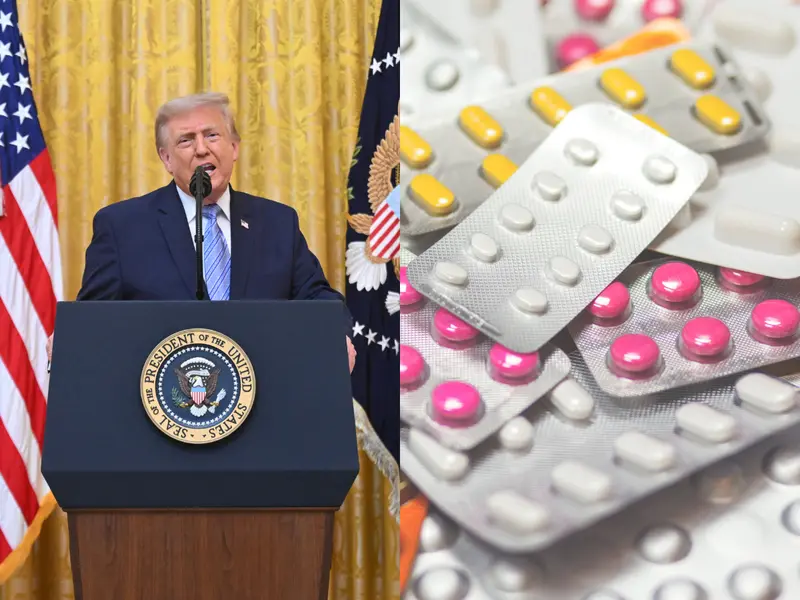


The United States has unveiled a sweeping new tariff policy on imported generic medicines, with President Donald Trump announcing a phased plan that could significantly impact pharmaceutical exporters, particularly India, the world’s largest supplier of generic drugs.
Under the new policy, generic medicines imported into the US will continue to enjoy zero tariffs for the next two years. However, beginning in August 2028, imports will face a 100% tariff for one year, followed by a 200% tariff thereafter.
The move is part of the Trump administration’s broader strategy to encourage pharmaceutical companies to manufacture generic medicines within the United States rather than relying on overseas production.
Trump Says Tariffs Aim to Bring Drug Manufacturing Back to the US
Announcing the decision on his Truth Social platform, Trump said the policy will take effect from August 1, 2026, while providing companies with a two-year transition period before higher duties come into force.
“Effective August 1st, 2026, all generic drugs being brought into the United States will continue to have a tariff of zero percent for two years, after which the tariff will be raised to 100 per cent for one year, and 200 per cent thereafter,” Trump wrote.
He said the phased tariff structure is intended to encourage pharmaceutical manufacturers to establish production facilities within the United States.
“This is done in order to RESHORE generic pharmaceutical production into America, with a penalty to those companies that decide not to build plants and equipment within the stated period of time given to them,” he added.
Trump also said the policy is designed to safeguard American interests while clarifying that existing rules governing patented and branded medicines will remain unchanged.
“The Policy on Patented, Branded, or Innovative Drugs, which has been so successful, will remain as is.”
India Could Be Among the Hardest-Hit Exporters
The announcement is expected to draw close attention in India, which is widely known as the “pharmacy of the world” because of its dominant role in manufacturing affordable generic medicines for global markets.
Indian pharmaceutical companies account for nearly 40% of the generic medicines used in the United States by volume, making the US one of the industry’s most important export destinations.
According to a report by the Global Trade Research Initiative (GTRI), India exported USD 9.7 billion worth of pharmaceutical products to the United States during the 2024-25 financial year. These shipments accounted for 38% of India’s total pharmaceutical exports, which stood at USD 25.8 billion.
The proposed tariff structure could therefore have significant implications for Indian drug manufacturers if implemented as announced.
Impact on Indian Pharma Companies Remains Unclear
While the tariff roadmap has been announced, its exact impact on Indian pharmaceutical companies remains uncertain.
India and the United States signed a trade agreement in February that reportedly stated India would “receive negotiated outcomes with respect to generic pharmaceuticals and ingredients.”
It is not yet clear how that understanding will interact with the newly announced tariff policy or whether exemptions or revised trade terms could emerge during future negotiations.
Indian Generic Medicines Play a Critical Role in US Healthcare
Indian-made generic medicines are widely used across the US healthcare system, treating a broad range of medical conditions including:
- Hypertension
- Diabetes
- Depression
- Cancer
- Infectious diseases
- Mental health disorders
According to a report by the Financial Post, Indian pharmaceutical companies also play a vital role in supplying contraceptive medicines in the United States.
The report found that around 65% of all birth control pill prescriptions filled in the US during 2024 were manufactured by just two Indian companies—Glenmark Pharmaceuticals Ltd. and Lupin Ltd.
Given the heavy reliance on Indian manufacturers for affordable medicines, industry observers are expected to closely monitor how the proposed tariffs could affect supply chains, drug prices, and future trade discussions between the two countries.