
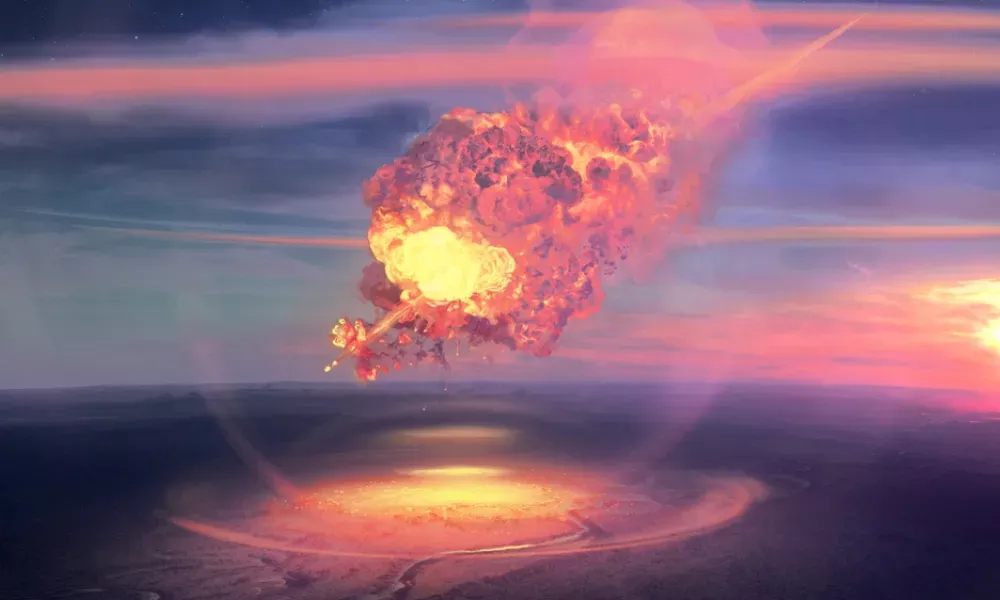


On the morning of June 30, 1908, during the reign of Tsar Nicholas II, a mysterious object from space streaked across the skies above one of the most isolated regions of Siberia. Within seconds, it unleashed an explosion so powerful that it flattened forests across thousands of square kilometres, generated seismic waves detected hundreds of miles away and left scientists with one of the greatest mysteries in modern history.
More than a century later, the Tunguska Event remains the largest impact-related explosion ever recorded in Earth’s atmosphere. Although no crater was found and no large meteorite fragments were recovered, the incident fundamentally transformed scientific understanding of asteroid impacts and continues to influence how governments prepare for threats from space.
A Summer Morning That Changed History
At around 7:15 a.m. on June 30, 1908, a blazing object entered Earth’s atmosphere over Siberia before exploding high above the ground near the Podkamennaya Tunguska River in what was then Yeniseysk Governorate, now part of Krasnoyarsk Krai, Russia.
The region, located nearly 4,000 kilometres east of Moscow, was sparsely populated by the Evenki people, whose eyewitness accounts became the earliest evidence of what had happened.
Witnesses described seeing a brilliant fireball, brighter than the Sun, streak across the sky while trailing smoke. Moments later came a blinding flash, followed by deafening explosions that shook the ground.
People closest to the blast reported being thrown into the air, with some losing consciousness as homes suffered severe damage. Others farther away described seeing an enormous column rising into the atmosphere, while herds of reindeer were reportedly killed by the blast. Seismic instruments located hundreds of kilometres away also recorded powerful tremors generated by the explosion.
Scientists now believe the object entered Earth’s atmosphere at an angle of roughly 30 degrees before exploding at an altitude of approximately 10 kilometres, releasing an enormous amount of energy without ever striking the ground.
“We know with high confidence that it was a meteoritic airburst,” Dr Mark Boslough, Research Associate Professor of Earth and Planetary Sciences at the University of New Mexico, told media.
He explained that although scientists are confident about the atmospheric explosion, several questions remain unanswered.
“There is still a large uncertainty in the magnitude of the event. I use the word ‘meteoritic’ to generically refer to either asteroid or comet because we don’t know which it was. We know precisely when it happened and what direction it came from, but we do not know its speed or physical properties,” he said.
A Mystery Hidden By Siberia’s Isolation
The remoteness of the blast site delayed scientific investigation for almost two decades.
The outbreak of the First World War, followed by the Russian Revolution and the country’s civil war, further postponed efforts to examine the devastated region.
In 1921, the Soviet Academy of Sciences sent geologist Leonid Kulik to investigate the explosion. However, the harsh terrain prevented him from reaching the epicentre.
It was only in 1927, nearly 19 years after the event, that Kulik finally arrived at the site.
Even after nearly two decades, the forest still bore unmistakable scars.
Near what was later identified as the epicentre, thousands of trees remained standing but had been stripped of branches and bark. Many showed signs of burning. Yet despite repeated expeditions, Kulik failed to discover the impact crater or any substantial meteorite fragments that scientists had expected.
According to Dr Martin Connors, Canadian astronomer and professor of astronomy, mathematics and physics, the delay in reaching the site significantly shaped scientific debate.
“It is surprising how much we do not know and that there remains controversy,” Dr Connors told media.
“The extremely remote location prevented immediate study and it was only years after the event that proper scientific work was carried out.”
At the time, the absence of an impact crater challenged existing scientific understanding.
“Comparing largely to what would have happened on the Moon, a crater and fragments were expected,” Dr Connors said.
“The concept of airbursts was not well understood then.”
He added that the Tunguska Event fundamentally changed scientific thinking.
“This event made us understand that airbursts could be important and that a physical impact was not needed to do damage.”
The Butterfly Pattern That Changed Everything
One of the most important discoveries came years later through aerial photography.
Scientists found nearly 2,150 square kilometres of forest flattened in a distinctive butterfly-shaped pattern, stretching between 23 and 56 kilometres from the epicentre.
According to Dr Boslough, this pattern proved to be one of the most significant scientific clues.
“The butterfly pattern may be one of the most important discoveries related to Tunguska because it can be reproduced experimentally and computationally,” he explained.
“It tells us that airbursts from asteroid collisions are quite different from nuclear airbursts. The size and shape of the butterfly pattern depends strongly on the energy and entry angle of the impactor, allowing us to improve disaster planning and identify potential danger zones.”
Ironically, what scientists failed to find—a crater—became the strongest evidence of all.
“The early expeditions failed to find the expected crater and meteorite fragments,” Dr Boslough said.
“But the biggest surprise came when aerial photographs showed all the trees blown away from a central point. That was the first clue that this was an airburst.”
Chelyabinsk Confirmed What Tunguska Suggested
More than a century later, another object entered Earth’s atmosphere over Russia.
In February 2013, an asteroid exploded over Chelyabinsk, producing dramatic footage seen around the world.
Although significantly smaller than the Tunguska object, the Chelyabinsk airburst injured more than a thousand people and shattered windows across the city.
For scientists, it also confirmed many long-held theories.
“The Tunguska airburst was at least ten times more powerful than the Chelyabinsk event,” Dr Boslough explained.
“It entered at a steeper angle, penetrated deeper into the atmosphere and exploded much closer to Earth’s surface, which explains why it caused much greater destruction.”
Chelyabinsk also strengthened confidence in computer simulations of atmospheric explosions.
“It reinforced the notion that airbursts are more dangerous than previously thought,” Dr Boslough said.
Dr Connors noted another crucial difference.
“Entire forests were blown down in Tunguska. Fortunately, there were no major population centres nearby. Had a large city been located there, the human losses would have been enormous.”
Asteroid Or Comet? Scientists Still Don’t Know
One of the longest-running debates surrounding Tunguska concerns the object’s identity.
Was it an asteroid or a comet?
Scientists have examined tree resin, peat deposits, microscopic particles and isotopic signatures for decades, yet the answer remains uncertain.
Dr Boslough believes the distinction may not be as important as often portrayed.
“The difference between asteroids and comets is blurry because comet fragments can evolve into asteroid-like objects after losing their volatile materials,” he explained.
Dr Connors agreed, saying more than a century of research has still not produced definitive evidence.
Eyewitness Accounts Match Modern Science
Remarkably, descriptions from local residents closely match modern scientific models.
Witnesses spoke of towering columns of fire, multiple thunderclaps and glowing skies that persisted for days.
Dr Boslough explained that today’s physics supports these observations.
The column of fire likely came from vaporised meteoritic material being ejected into the atmosphere.
The repeated thunderclaps were caused by multiple sonic booms as fragments broke apart.
The glowing skies, once a mystery, are now believed to have been created by high-altitude dust clouds similar to those observed after Comet Shoemaker-Levy 9 struck Jupiter.
Dr Connors added that these glowing skies were observed well beyond Siberia.
“They were seen worldwide, showing that dust was injected into the upper atmosphere and transported around the globe.”
Could Another Tunguska Happen?
Scientists say atmospheric explosions continue to occur, although most involve much smaller objects that burn up harmlessly.
The greatest concern is posed by larger objects capable of producing destructive airbursts.
Dr Boslough warned that warning times remain limited, particularly for objects approaching from the direction of the Sun.
However, future missions could significantly improve detection capabilities.
NASA’s Near-Earth Object Surveyor, scheduled for launch in 2027, and the Vera C. Rubin Observatory are expected to identify far more potentially hazardous asteroids and predict their future paths with greater accuracy.
Tunguska’s Lasting Legacy: Protecting Earth
The Tunguska Event has profoundly influenced modern planetary defence strategies.
Today, NASA’s Planetary Defense Coordination Office tracks potentially hazardous Near-Earth Objects, while the agency’s successful Double Asteroid Redirection Test (DART) demonstrated that humanity can alter an asteroid’s trajectory if necessary.
The DART mission successfully changed the orbit of Dimorphos, marking the world’s first successful asteroid-deflection experiment.
More than 118 years after the skies exploded over Siberia, Tunguska remains more than a historical mystery. It serves as a reminder that while such events are rare, they are real—and understanding them could one day help protect Earth from a future cosmic disaster.