
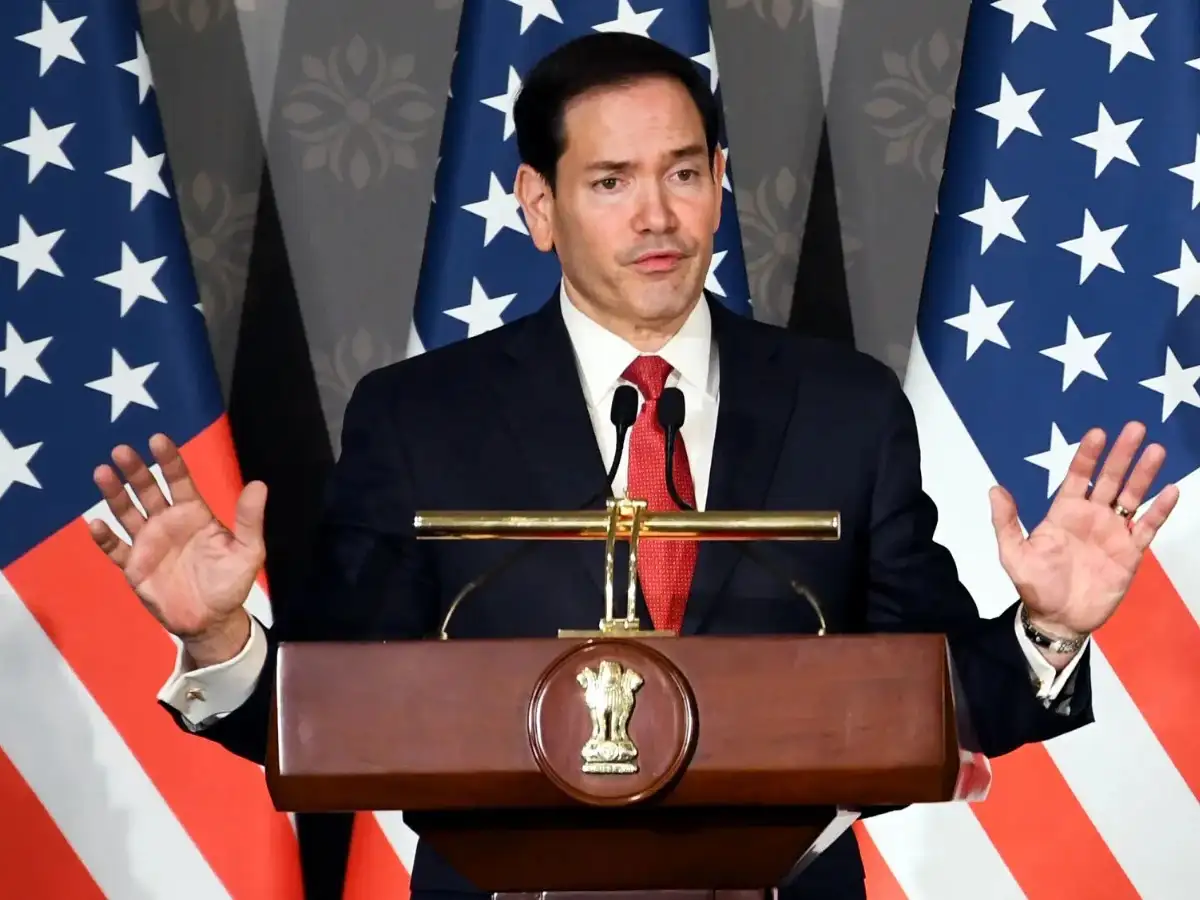


Washington/New Delhi: US Secretary of State Marco Rubio’s recent claim that India has committed to purchasing $500 billion worth of American goods over the next five years has sparked intense debate among economists, trade analysts and political observers, with many questioning whether the arrangement disproportionately benefits the United States.
Rubio made the remarks before leaving India earlier this week, stating that New Delhi had agreed to significantly ramp up imports from the US in sectors such as energy, technology and agriculture. His comments immediately drew attention because of the sheer scale of the proposed purchases and the timing of the statement amid shifting global trade dynamics.
The remarks have also reignited scrutiny over the interim India-US trade agreement announced earlier this year, particularly regarding what India may actually gain in return.
Why Experts Are Questioning The Deal
A report by the Financial Times described the situation as “puzzling”, noting that the trade environment has changed considerably since the original understanding between the two countries was reached.
The report questioned why India would continue pursuing such a large-scale import commitment when the core incentives that initially justified the arrangement may no longer exist.
“It would be foolish for India to sign an agreement that appears to take far more than it gives,” the report said, highlighting concerns that India may be locking itself into a costly trade obligation without securing enough long-term benefits.
How The $500 Billion Figure Emerged
The figure was first mentioned in February this year when India and the US announced an interim trade understanding.
At that time, US President Donald Trump had reduced tariffs on Indian goods from 50 per cent to 18 per cent, a move that was welcomed by Indian exporters and policymakers.
In exchange, the White House said India intended to more than double annual imports of American products across several sectors, including information technology equipment, coal, aircraft, aviation components and agricultural goods.
India’s Ministry of Commerce included the commitment in its official communication of the agreement, although the point received relatively little public attention at the time.
Commerce Minister Piyush Goyal later defended the proposed import target, arguing that the number was “very conservative” considering India’s economic growth trajectory. He said India’s rapidly expanding aviation sector alone could account for nearly $100 billion in purchases over the next five years.
What Changed After The Initial Agreement
However, the circumstances shifted dramatically later in the year.
The US Supreme Court ruled that President Trump’s sweeping reciprocal and fentanyl-linked tariffs were illegal. Following the ruling, the Trump administration invoked Section 122 of the Trade Act of 1974 and imposed a uniform 10 per cent tariff on all trading partners, regardless of whether they had negotiated bilateral arrangements with Washington.
This effectively diluted the special tariff advantage India believed it had secured under the earlier agreement.
Trade analysts now argue that continuing with the same $500 billion purchase commitment under the new conditions appears increasingly difficult to justify.
The Financial Times report said it was “rather bizarre” that India was still pursuing the import target despite the changed tariff landscape and Rubio’s assertion that the target now represented a formal “commitment.”
Concerns Over India’s Trade Balance
Economists have also warned that the scale of the proposed imports could put pressure on India’s already fragile trade balance.
India is currently facing multiple economic challenges, including a weakening rupee, rising oil prices linked to tensions in the Middle East and pressure on foreign exchange reserves.
Experts argue that sharply increasing imports from the US could further widen India’s trade deficit unless accompanied by a corresponding rise in exports.
India recorded a total goods trade deficit of $283.5 billion in 2024-25.
“The math doesn’t add up,” Madhavi Arora, economist at Emkay Global, told Reuters, describing the target as “more aspirational than realistic.”
Independent trade expert Biswajit Dhar also questioned the feasibility of importing $100 billion worth of American goods every year.
“If it is $100 billion every year, it would completely upset India’s trade balance,” he said, adding that the agreement appears focused more on preserving access to India’s market than boosting Indian exports.
Analysts also noted that India may lose leverage if it becomes too dependent on American suppliers in key sectors such as aviation and energy.
The Financial Times report specifically questioned why India would not keep supplier options open to secure better pricing and technology partnerships from multiple countries instead of concentrating purchases from the US.
Political And Strategic Context Behind The Deal
Rubio’s visit came at a delicate moment in India-US relations.
Many in India have expressed concern over President Trump’s recent diplomatic outreach towards China and Pakistan. At the same time, frustration has grown in New Delhi over Washington’s increasingly aggressive tariff policies.
For months, India was expected to become one of the first major countries to finalise a comprehensive trade agreement with the Trump administration. Instead, India ended up among the nations facing some of the heaviest tariff pressures.
According to a New York Times report, successive Republican and Democratic administrations over the past two decades had worked to build stronger strategic ties with India.
However, Trump’s tariff-driven approach and his repeated claims regarding mediation in India-Pakistan tensions have complicated that relationship.
The report also noted that Trump’s decision to impose punitive tariffs on India came shortly after Prime Minister Narendra Modi reportedly declined to nominate him for a Nobel Peace Prize.
Rubio And Jaishankar Defend The Relationship
Despite the concerns, Rubio insisted during his visit that India-US relations remain strong.
“The US-India relationship has not lost any momentum… the relationship continues to be strong,” he said during a press conference in New Delhi.
When asked about tariffs, Rubio urged India not to take the measures personally.
“There’s a huge imbalance that’s built up, and it needs to be addressed. This is not about India,” he said.
Standing alongside Rubio, External Affairs Minister S Jaishankar acknowledged that the Trump administration was openly pursuing an “America First” strategy.
“We have a view of ‘India First’,” Jaishankar said, signalling that New Delhi would continue prioritising its own economic interests while navigating the evolving trade relationship with Washington.
Uncertainty Remains Over Final Terms
While Rubio’s comments have intensified public debate, neither government has released a detailed framework explaining how the proposed $500 billion target would be achieved or enforced.
It also remains unclear whether the figure represents a legally binding commitment, a policy aspiration or a broad trade projection based on future economic growth.
Until more details emerge, the proposed trade expansion is likely to remain under intense scrutiny from economists, businesses and political observers in both countries.