
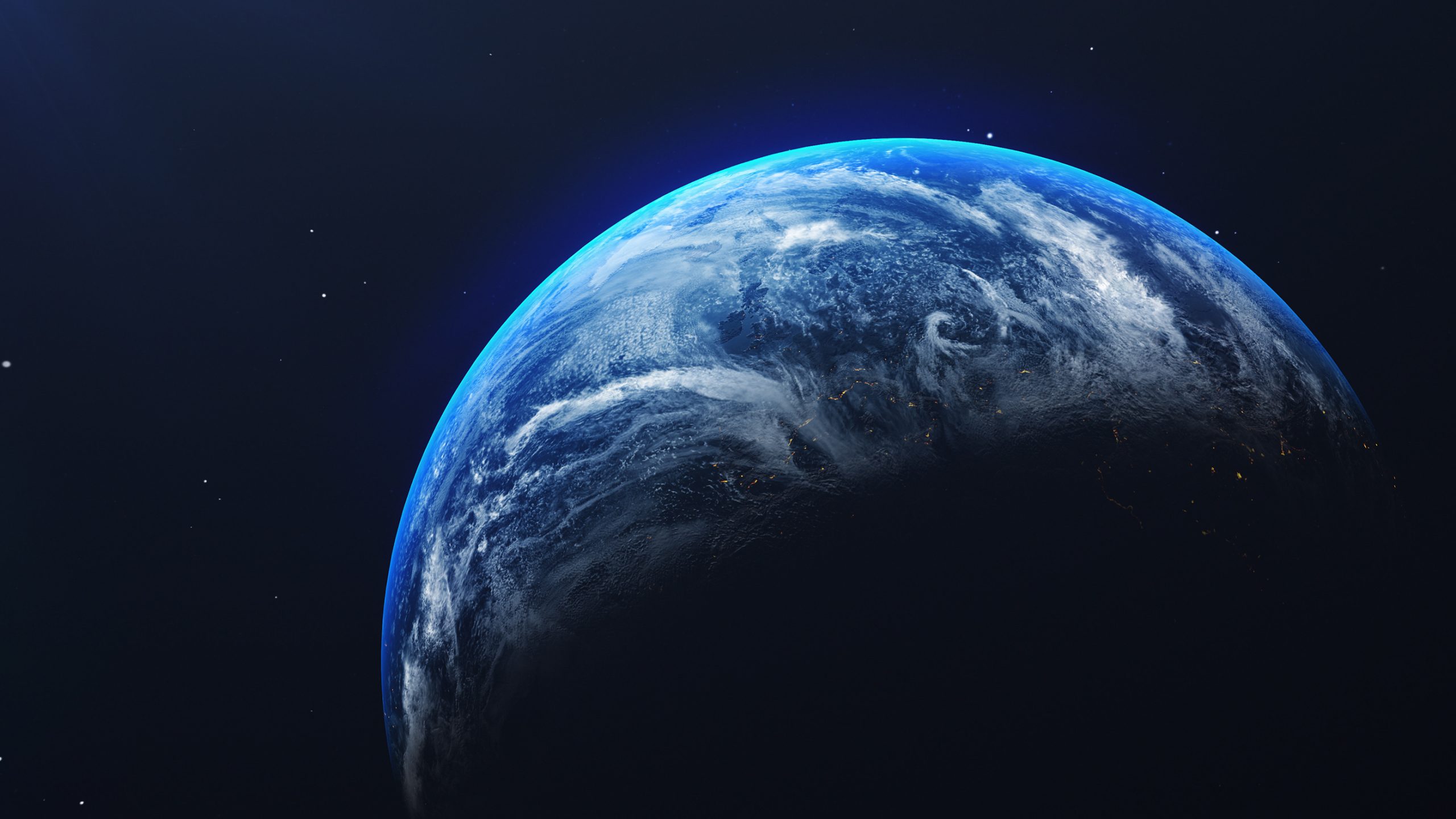


A new scientific study suggests that Earth’s biosphere may remain habitable for far longer than previously estimated, despite the Sun gradually becoming brighter over time.
Using advanced three-dimensional climate models, researchers found that Earth’s future depends not only on increasing solar radiation but also on how atmospheric carbon dioxide (CO₂) changes over billions of years.
Two Possible Climate Scenarios
Researchers examined two long-term scenarios:
1. Strong Weathering
- Surface temperatures remain relatively stable.
- Atmospheric CO₂ is gradually removed through natural weathering.
- Most plants using C4 photosynthesis would struggle once CO₂ falls below 10 parts per million (ppm).
- This threshold is projected to occur around 1.35 billion years from now.
However, some forms of life could survive longer.
Plants using Crassulacean Acid Metabolism (CAM) photosynthesis and aquatic plants capable of using dissolved bicarbonate may continue to thrive under extremely low CO₂ conditions.
If life can persist until atmospheric CO₂ reaches 1 ppm, Earth’s vegetative biosphere could survive for as long as 1.84 billion years.
2. Weak Weathering
- Atmospheric CO₂ remains relatively constant.
- Rising solar energy steadily heats the planet.
Under this scenario:
- Around 1.68 billion years from now, Earth’s average surface temperature could exceed 323 K (about 50°C), making conditions unsuitable for most land plants.
- By approximately 1.87 billion years, temperatures could surpass 338 K (about 65°C), rendering the planet inhospitable for all land vegetation.
These conditions approach a moist greenhouse and eventually a runaway greenhouse state, where Earth could become increasingly similar to present-day Venus.
Adaptation Could Extend Life
The researchers emphasize that Earth’s future is determined by the interaction between rising temperatures and declining CO₂—not by either factor alone.
They suggest that, in theory, an advanced civilization might one day help prolong Earth’s habitability through measures such as:
- Regulating atmospheric CO₂ levels.
- Reducing the amount of solar radiation reaching Earth.
- Engineering crops and plants capable of surviving extreme heat and low CO₂ environments.
A More Hopeful Outlook
While Earth’s biosphere will ultimately reach its limits through either carbon starvation or extreme heat, the study suggests that life may prove more resilient than previously believed.
Instead of facing an abrupt end, Earth’s living systems could continue adapting for nearly two billion more years, highlighting the remarkable persistence of life in the face of a changing Sun.