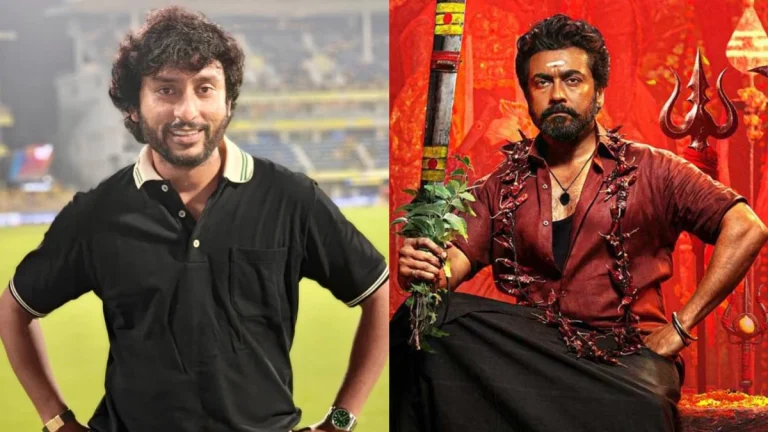
Karuppu may appear like a traditional commercial entertainer on the surface, but beneath its mass-hero moments lies a deeply emotional story about flawed human beings, delayed justice, and the limitations of even divine intervention. Directed by RJ Balaji, the film uses mythology and courtroom drama to explore the emotional realities of ordinary people struggling within a broken system.
What Is Karuppu About?
The story revolves around Baby Kannan, played by RJ Balaji, a manipulative lawyer who exploits vulnerable clients for money while operating within a collapsing judicial system.

The courtroom itself mirrors the moral decay surrounding him — physically crumbling and emotionally bankrupt. Desperate people continue approaching him because they have nowhere else to go.
When injustice becomes unbearable, a divine force enters the narrative. Suriya appears as advocate Saravanan, a human form of the guardian deity Karuppuswamy, determined to restore justice where the system has failed.
The Emotional Core Lies In Its Human Characters
While the film centres around a divine saviour, its emotional strength comes from the ordinary people caught in painful circumstances.
The story of Binu, played by Anagha Maaya Ravi, and her father Sukumaran, portrayed by Indrans, becomes the heart of the film.
Travelling from Kerala to Tamil Nadu for Binu’s liver transplant treatment, the father-daughter duo loses their gold savings to theft. Their long and exhausting battle through police stations and courts exposes how the legal system often drains victims emotionally and financially before offering any relief.
Suriya’s Guardian Deity Is Powerful Yet Restrained
Unlike typical larger-than-life mass heroes, Suriya’s Karuppu operates within self-imposed moral boundaries. He initially refuses to misuse divine powers and instead attempts to follow legal procedures.
However, the film repeatedly questions whether law alone can deliver timely justice in a deeply corrupted system.
As innocent lives continue to suffer, the deity is forced to confront the limitations of patience, morality, and procedure.
Trisha Krishnan Adds Emotional Balance
Trisha Krishnan plays advocate Preethi, one of the few morally grounded characters in the film.
Her conversations with Saravanan challenge the very idea of divine responsibility. She questions why suffering continues even when a protector exists, pushing the film into philosophical territory beyond standard commercial cinema.
RJ Balaji Uses Mass Cinema To Explore Harsh Realities
Though packed with commercial elements, Karuppu pauses frequently to reflect on grief, helplessness, corruption, and delayed justice.
The film suggests that many citizens feel abandoned by systems meant to protect them. Even when divine intervention exists, humanity’s greed, selfishness, and cruelty often complicate justice further.
This balance between mythology and realism becomes the film’s defining strength.
Themes Of Justice, Faith, And Human Failure
Karuppu ultimately becomes less about hero worship and more about society itself.
Key Themes Explored In The Film
- Failure of legal systems
- Emotional cost of delayed justice
- Corruption within institutions
- Human greed and helplessness
- Faith in divine intervention
- Moral responsibility and empathy
The narrative repeatedly shows that while gods may guide people, human actions continue to shape outcomes.
Final Verdict
Karuppu succeeds because it refuses to rely solely on spectacle. While Suriya delivers the charisma expected from a mass hero, the film’s true emotional impact comes from its wounded, vulnerable, and painfully realistic human characters.
RJ Balaji crafts a socially conscious entertainer that mixes mythology, courtroom drama, and emotional storytelling into a film that feels both commercially engaging and emotionally resonant.