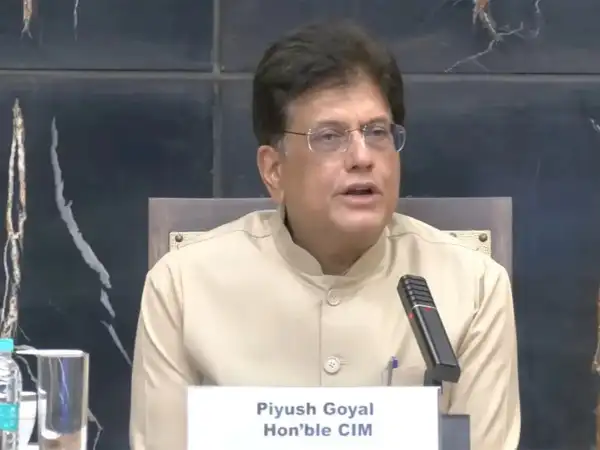
New Delhi/Washington: India is pushing to secure preferential market access for its domestic goods in the United States as negotiations on the first phase of the bilateral trade agreement move forward in Washington, Commerce and Industry Minister Piyush Goyal said on Monday.
Speaking to reporters, Goyal confirmed that negotiations have reached an advanced stage, with both sides working to finalise the initial tranche of the long-awaited trade deal.
“We have almost finalised the free trade agreement, the first tranche of the bilateral trade agreement with them,” he said.
“We are trying to work out what would be the mechanism by which India can get preferential market access in the US market compared to our competitors,” he added.
Indian Delegation Holds Three-Day Talks In Washington
Around a dozen Indian officials are currently in Washington, D.C. for a three-day round of negotiations with US authorities. During these discussions, the Indian side is expected to focus on securing better market access terms for Indian goods.
Officials indicated that the recent changes in the US tariff structure have prompted both sides to reconsider parts of the agreement framework, which was originally released on February 7.
A planned meeting between the chief negotiators in February had been postponed due to legal and policy changes affecting US tariffs. Negotiations have now resumed, with talks scheduled from April 20, 2026.
US Tariff Policy Changes Prompt Recalibration Of Deal
The negotiations come amid significant shifts in US tariff policy under President Donald Trump.
Earlier, the US had agreed to reduce tariffs on Indian goods to 18% from 50%, including removing a 25% tariff imposed on Indian imports linked to India’s purchase of Russian oil. The remaining tariff was also expected to be reduced under the agreement.
However, the tariff landscape changed after the United States Supreme Court ruled against the sweeping reciprocal tariffs introduced under the International Emergency Economic Powers Act (IEEPA) of 1977.
Following the ruling, the Trump administration imposed a uniform 10% tariff on imports from all countries for a temporary period of 150 days starting February 24, forcing both India and the US to reassess previously agreed terms.
With all US trading partners now facing the same tariff level, India’s earlier comparative advantage under the agreement has been reduced, making recalibration necessary.
India Offered Tariff Cuts On US Goods And Major Import Commitments
Under the original framework, India had proposed to eliminate or reduce tariffs on a wide range of US industrial goods and agricultural products.
These included items such as:
- Dried distillers’ grains (DDGs)
- Red sorghum used in animal feed
- Tree nuts
- Fresh and processed fruits
- Soybean oil
- Wine and spirits
- Several additional industrial and agricultural products
India had also indicated its intention to significantly increase imports from the United States. The proposal included purchasing USD 500 billion worth of US products over five years, covering:
- Energy products
- Aircraft and aircraft components
- Precious metals
- Technology products
- Coking coal
Such commitments were expected to strengthen bilateral trade ties and help balance trade relations between the two countries.
China Overtakes US As India’s Largest Trading Partner
The broader trade landscape has also shifted significantly in recent months.
According to official data, China overtook the United States to become India’s largest trading partner during the 2025–26 financial year, ending the US’s four-year streak as India’s top trading partner until 2024–25.
India’s exports to the United States recorded marginal growth of 0.92%, reaching $87.3 billion during the last fiscal year. Meanwhile, imports from the US rose 15.95% to $52.9 billion.
As a result, India’s trade surplus with the United States declined to $34.4 billion in 2025–26, compared to $40.89 billion in 2024–25.
Global Trade Environment Adds Pressure To Secure Competitive Terms
With global tariff rules shifting and multiple countries negotiating new trade terms with Washington, India is working to ensure that its exporters remain competitive in the US market.
Officials noted that many countries are currently reviewing their trade relationships with the United States following recent tariff changes. In this evolving environment, securing preferential access is seen as essential to maintaining India’s export momentum.
The outcome of the ongoing Washington talks is expected to shape the future of India–US trade relations and influence market access opportunities for several Indian industries.