
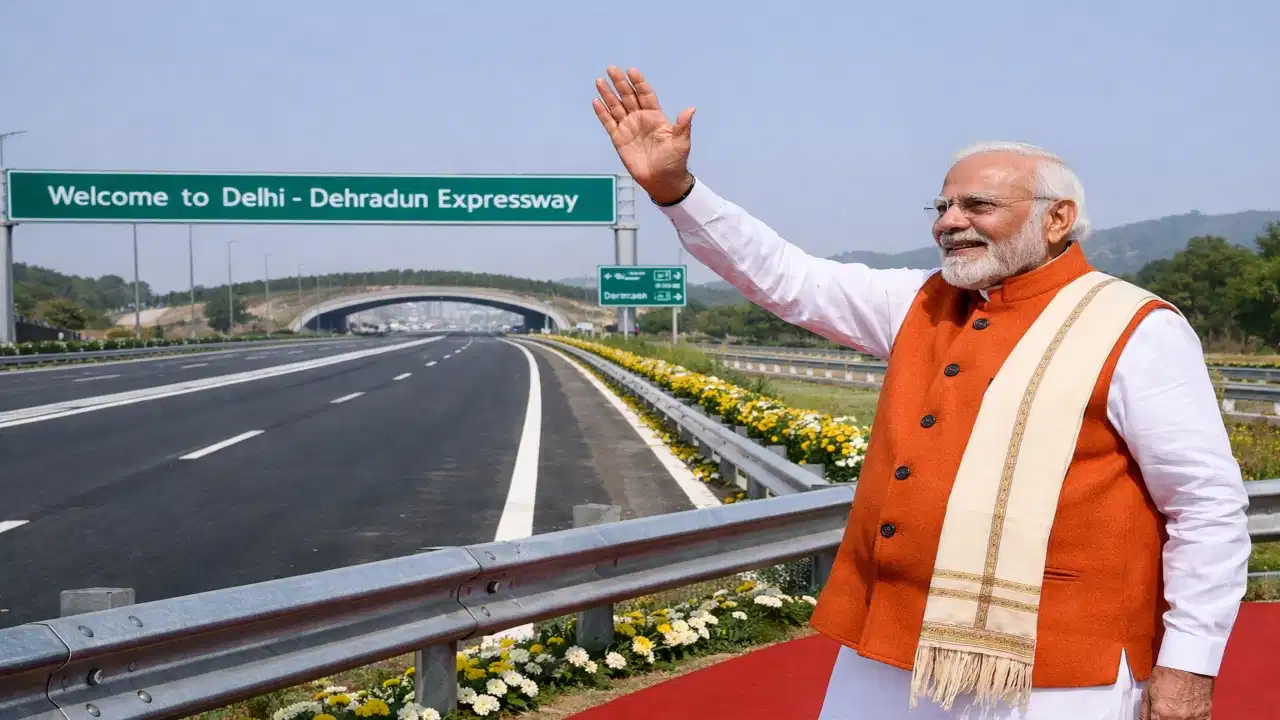


The wait is finally over for commuters traveling between the national capital and the foothills of the Himalayas. Prime Minister Narendra Modi is set to officially inaugurate the Delhi-Dehradun Expressway today, marking a historic shift in regional connectivity. The Prime Minister’s itinerary includes a visit to Saharanpur in Uttar Pradesh to personally review the landmark wildlife corridor before heading to the Jai Maa Daat Kali Temple near Dehradun to perform a traditional pooja ahead of the ceremony.
Commonly referred to as the Delhi-Dehradun Economic Corridor, this project is designed to transform the transit landscape for millions of travelers in Delhi, Uttar Pradesh, and Uttarakhand.
1. A Game-Changer for Travel Time
The primary draw of this new expressway is the sheer speed of transit. Currently, the journey from Delhi to Dehradun can take upwards of six hours due to heavy traffic and narrow stretches. Once fully operational today, that time is expected to drop to just two and a half hours. This massive reduction makes Dehradun and Haridwar easily accessible for weekend getaways and significantly boosts trade logistics.
2. A ₹11,868.6 Crore Engineering Marvel
This mega infrastructure project has been a long time in the making. The foundation stone was first laid in February 2021 by Union Minister Nitin Gadkari, followed by a second stone-laying ceremony by PM Modi in December of that year. Built at a staggering cost of nearly ₹11,869 crore, the project overcame several geological and environmental hurdles to reach completion.
3. Phase-by-Phase Integration
While the full length opens today, segments of the project have been coming online incrementally. A crucial 32-km stretch starting from Akshardham in Delhi and passing through Geeta Colony, Shastri Park, and Mandola Vihar was completed in mid-2025. It has been serving the public since December 2025, providing much-needed relief to commuters in East Delhi and Ghaziabad.
4. India’s Most Wildlife-Friendly Highway
Perhaps the most impressive feature of the corridor is its commitment to conservation. A 12-km elevated section passes through the Rajaji National Park, making it one of the longest wildlife corridors in Asia. The design includes:
- Six animal underpasses and eight animal passes.
- Two 200-metre-long elephant underpasses specifically designed for safe migration.
- A 370-metre tunnel near the Daat Kali temple to avoid disturbing the sensitive forest floor.
5. Seamless Connectivity to Major Hubs
The expressway is more than just a straight line; it is a hub of connectivity. With over 100 underpasses and five railway overbridges, it integrates seamlessly with:
- The Delhi-Mumbai Expressway
- The Eastern Peripheral Expressway (EPE)
- Dedicated spurs leading to Haridwar and Roorkee
6. Breaking Down the Four Construction Phases
The project was executed in four distinct phases to manage the diverse terrain:
- Phase 1: A 32-km, 12-lane expanse from Akshardham Temple to the EPE near Baghpat.
- Phase 2: A 118-km, 6-lane stretch from the EPE to the Saharanpur Bypass, featuring 60 underpasses.
- Phase 3: A 40-km section from the Saharanpur Bypass to Ganeshpur.
- Phase 4: The final 20-km mountainous stretch from Ganeshpur to Dehradun, featuring twin tunnels and the elevated wildlife corridor.
7. Smart Safety: The ATMS Advantage
Safety is not an afterthought on this corridor. The highway is equipped with an Advanced Traffic Management System (ATMS). This technology uses real-time monitoring to manage traffic flow, detect accidents instantly, and provide emergency assistance, ensuring that high-speed travel does not compromise passenger safety.