
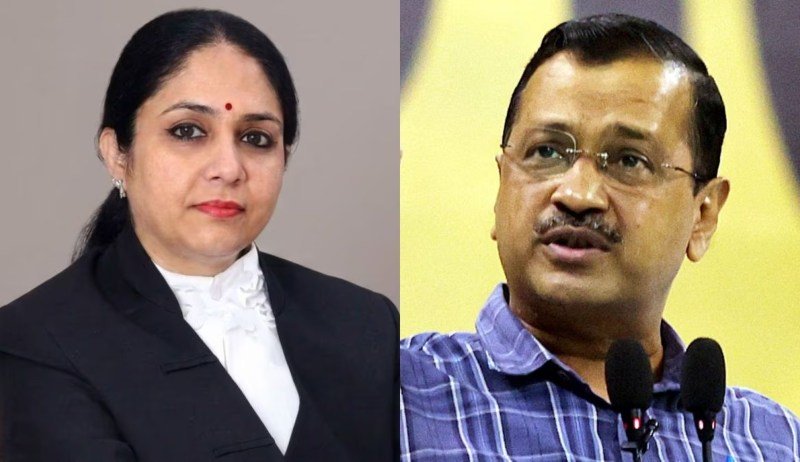

 is currently challenging a trial court order that discharged Kejriwal and Sisodia)
The Central Bureau of Investigation (CBI) is currently challenging a trial court order that discharged Kejriwal and Sisodia. During the high-stakes hearing, Justice Sharma delivered a detailed judgment lasting over an hour. She emphasized that a judge must remain neutral and cannot abdicate their duty simply because a litigant fears an unfavorable outcome.
Court Rejects “Conflict of Interest” Allegations
Arvind Kejriwal personally argued for the recusal, raising several points regarding perceived bias. However, Justice Sharma dismantled these arguments one by one:
The “Children” Argument: Kejriwal claimed a conflict of interest because the judge’s children are empanelled with the central government. The court ruled that the profession of a judge’s family cannot be exploited to seek recusal without proof of actual misuse of office.
Political Events: The judge addressed her attendance at events organized by the Akhil Bharatiya Adhivakta Parishad (ABAP). She clarified that engaging with the legal fraternity does not indicate a political association.
Institutional Integrity: Justice Sharma warned that stepping aside without a “demonstrable cause” would set a troubling precedent. She stated that if judges bow to such vilification, it would attack the entire judicial institution.
“Justice Administered, Not Managed”
The judge noted that accepting such applications would make the judicial process vulnerable to the discomfort of litigants. She remarked that the Constitution does not permit a path where the adjudicatory process is shaped by those being judged.
“If recusal on such grounds is accepted… it would not be justice administered, it will be justice managed,” the judge noted.
Political Reactions Split
The verdict immediately triggered a fresh war of words between the BJP and AAP:
BJP’s Stance: Delhi Chief Minister Rekha Gupta accused Kejriwal of trying to cast aspersions on the judiciary to erode public confidence.
AAP’s Stance: Saurabh Bharadwaj expressed dissatisfaction, stating that the leaders had “reasonable apprehension” of an unfair trial based on ten specific points that the court found legally untenable.
Timeline of the Excise Policy Case (2026)
The legal battle over the now-scrapped liquor policy continues to see rapid developments in the High Court.
| Date | Event |
| Feb 27 | Trial court discharges Kejriwal and Sisodia, citing no prima facie case. |
| March 9 | Justice Sharma stays the trial court’s order for departmental action against a CBI officer. |
| April 16 | Kejriwal formally asks Justice Sharma to recuse herself from the appeal. |
| April 20 | Justice Sharma dismisses the recusal plea in a detailed judgment. |
| April 29-30 | Next scheduled hearing; CBI to begin arguments. |
The court has granted Kejriwal and other respondents a final chance to file their responses. Consequently, the CBI will begin its arguments on April 29, as the High Court seeks to determine if the trial court was correct in discharging the AAP leaders.