
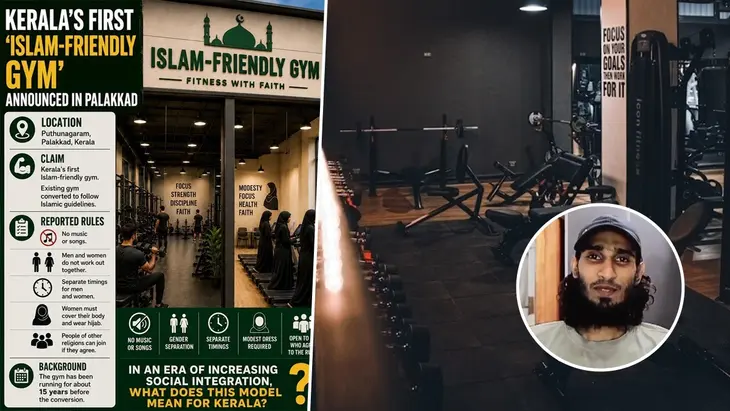


A local fitness center in Palakkad’s Puthunagaram area has unexpectedly found itself at the center of a nationwide conversation. Gym owner Nawaz Muthu T, who has successfully operated the commercial facility for around 15 years, recently announced a complete operational overhaul, relaunching it as Kerala’s very first “Islam-friendly” gym.
The announcement, rolled out via a promotional video that quickly went viral, immediately triggered a storm of praise, parody, and highly charged political commentary across social media platforms. However, stripping away the digital noise reveals a distinct set of practical, faith-based choices designed to cater to a traditional demographic that has historically stayed away from modern commercial fitness culture.
What Does ‘Islam-Friendly’ Actually Mean?
Following an immediate wave of online backlash, the original promotional video was taken down, and Nawaz posted a detailed clarification video to address the public anxiety. He explicitly emphasized that the facility is not a Muslim-only space. Anyone, regardless of their personal faith, is welcome to join and train, provided they strictly adhere to the facility’s newly structured rules.
Nawaz’s business rationale is inherently practical. He explained that many observant Muslims—including members of his own immediate family—actively avoid mainstream gyms due to mixed-gender workout hours and inescapable, blaring background music. “There is no gym for them,” Nawaz pointed out in his clarification video. “When you go to a gym, it is not possible to switch off the music.” His re-imagined facility aims to address that exact market gap.
Gym at a Glance: New Operational Rules
| Feature / Metric | Operational Policy Details | Intended Demographic Impact |
| Acoustic Environment | No loud background music; personal headphones permitted | Accommodates those avoiding public music entertainment |
| Gender Segregation | Men and women assigned entirely separate workout time slots | Ensures privacy and comfort during intense workouts |
| Trainer Allocations | Male trainers for male members; female trainers for female members | Aligns with conservative boundary preferences |
| Dress Code | Women expected to dress modestly; hijab required | Removes dress-related anxiety for conservative women |
| Membership Bounds | Strictly open to individuals of all faiths and backgrounds | Functions as a universal commercial business |
Global and Domestic Precedents for Modest Fitness
While the announcement has shocked local regional circles, the concept of modest, faith-coded fitness spaces is well-established internationally.
In the United Kingdom, women-only health clubs such as Health Club for Her in Batley and WOH Gym in Newport have quietly flourished, providing private environments for Muslim women to exercise without standard attire worries. Similarly, in US cities like Minneapolis, a growing network of fitness clubs offers private spaces allowing women to exercise comfortably without maintaining a hijab.
The shift is backed by substantial data. A benchmark UK study revealed that 86% of British Muslim women expressed a clear preference for women-only gyms or fitness classes. This preference has transformed the global modest fashion market into an engine projecting massive growth, with Islamic activewear emerging as a primary commercial segment.
The Dark Shadow of the Banned PFI
The intense public scrutiny surrounding the Palakkad gym is deeply tied to Kerala’s complex security history. Online commentators immediately attempted to connect the faith-based branding to the illicit activities of the now-banned Popular Front of India (PFI).
That public anxiety has a factual foundation, though it stems from a completely different category of facility. The National Investigation Agency (NIA) has previously attached multiple covert PFI arms and physical training camps across Kerala—most notably the Green Valley Academy in Manjeri. Investigations revealed that the PFI frequently utilized the guise of charitable, educational, or athletic trusts to train cadres in weapons and explosives.
However, security officials have noted there is no established link whatsoever between those illegal, covert training operations and legitimate, tax-paying commercial fitness centers like Nawaz’s facility.
The Bigger Societal Debate
The online reaction to the Puthunagaram gym remains sharply divided. Supporters argue that the model democratizes wellness, with one user posting: “There would be more women joining a gym if they knew they wouldn’t have to parade in front of strange men.” Conversely, critics express skepticism over whether religious branding belongs in public, secular commercial spaces.
Ultimately, the gym’s true significance may transcend religious boundaries. It highlights an unaddressed structural gap in India’s fitness economy: for millions of women across diverse communities, securing a safe, private, and culturally comfortable space remains the very first hurdle to clear long before they even step onto a treadmill.