


The ongoing NEET UG 2026 paper leak controversy has once again triggered a nationwide debate over the security of India’s competitive examination system. Every year, nearly 20 to 25 lakh students appear for the National Eligibility cum Entrance Test (NEET), making it one of the country’s biggest and most competitive entrance examinations for medical admissions.
However, repeated allegations of paper leaks, irregularities, impersonation rackets and exam management failures have raised serious questions about the integrity of the system. As investigations continue into the latest alleged leak, many have begun comparing India’s exam framework with China’s Gaokao — a much larger examination system that rarely witnesses such controversies publicly.
What Is China’s Gaokao Examination?
The Gaokao is China’s national college entrance examination and is considered one of the toughest academic tests in the world. Conducted once every year, it acts as the primary gateway for admission into universities across China.
Unlike NEET, which is limited to medical and dental admissions, the Gaokao determines entry into almost all major undergraduate programmes and institutions in the country. A student’s score plays a crucial role in deciding not just the university they can enter, but also the courses they are eligible to study.
The scale of the exam is enormous. Around 1.3 crore students reportedly appear for the Gaokao annually — several times higher than NEET’s participation numbers.
Why China’s Gaokao Is Seen As More Secure
One of the key reasons often cited behind the Gaokao’s reputation for being leak-resistant is China’s highly centralised and tightly monitored examination system.
Authorities reportedly deploy multiple layers of surveillance and technological safeguards to prevent cheating, leaks or malpractice. These measures include:
- AI-enabled monitoring systems in examination halls
- Biometric identity verification
- Electronic signal jammers to block communication devices
- Drone surveillance in sensitive examination zones
- Strict transportation and handling protocols for question papers
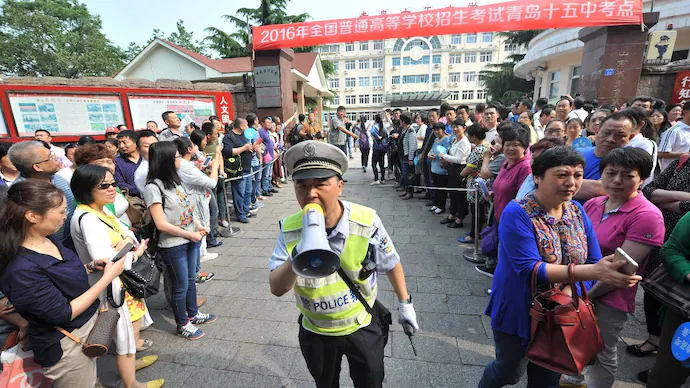
- Heavy police deployment around exam centres
In several Chinese cities, traffic movement and public activities are also regulated during examination hours to minimise disturbances and maintain a controlled environment.
NEET Continues To Face Scrutiny
In contrast, NEET has repeatedly found itself at the centre of controversies over the years. Allegations have ranged from paper leaks and impersonation scams to issues involving examination centres, answer keys and result processing.
The latest NEET UG 2026 paper leak case has further intensified concerns. Investigators have uncovered what appears to be a large network involving the circulation of “guess papers”, encrypted messaging platforms, and coaching centre links spread across multiple states.
The National Testing Agency (NTA) has already cancelled the NEET UG 2026 examination following the controversy, while the Centre has handed over the probe to the Central Bureau of Investigation (CBI).
A Matter Of Scale And Administration
Education experts point out that while both exams operate on a massive scale, the administrative structures behind them are significantly different.
China’s Gaokao functions under a highly centralised governance system with extensive state oversight and severe penalties for violations. The examination is treated as a national priority, with coordinated efforts involving local administrations, police authorities and technology infrastructure.
In India, the examination ecosystem is far more decentralised, involving multiple agencies, private vendors, state-level logistics networks and large-scale movement of question papers across regions. This complexity often creates vulnerabilities that can be exploited.
Why The Comparison Matters
The comparison between NEET and Gaokao has once again reignited conversations around exam reforms in India. Students, parents and education experts have increasingly demanded stronger digital security measures, tighter monitoring of examination logistics and stricter action against organised cheating networks.
For millions of aspirants, competitive exams represent years of preparation and enormous emotional pressure. Any compromise in exam integrity directly impacts trust in the system.
As the investigation into the NEET UG 2026 leak progresses, the larger debate remains unchanged: how can India strengthen the credibility and security of its high-stakes examinations in an era of organised digital malpractice?