


Notre Dame Excavation Reveals Hidden Roman and Medieval Paris Beneath Cathedral Square
A major archaeological excavation beneath the square in front of Paris’ iconic Notre Dame Cathedral is shedding new light on more than 2,000 years of the city’s history.
What began as a redevelopment project aimed at making the cathedral’s forecourt cooler and more welcoming for visitors has evolved into one of the most significant archaeological investigations in recent French history. Dubbed the “dig of the century” by local media, the excavation is uncovering layers of Roman, medieval and early French civilisation buried beneath one of the world’s most visited landmarks.
Redevelopment Project Leads to Historic Discoveries
Following the devastating 2019 fire that destroyed Notre Dame’s spire, the cathedral underwent a massive restoration effort before reopening to the public in late 2024.
Paris authorities are now working on the next phase of the site’s transformation, which includes adding trees, shaded spaces and cooling features to the large square in front of the cathedral.
However, before any landscaping work could begin, archaeologists were required to investigate what lay beneath the historic site to ensure valuable heritage remains were not damaged during construction.
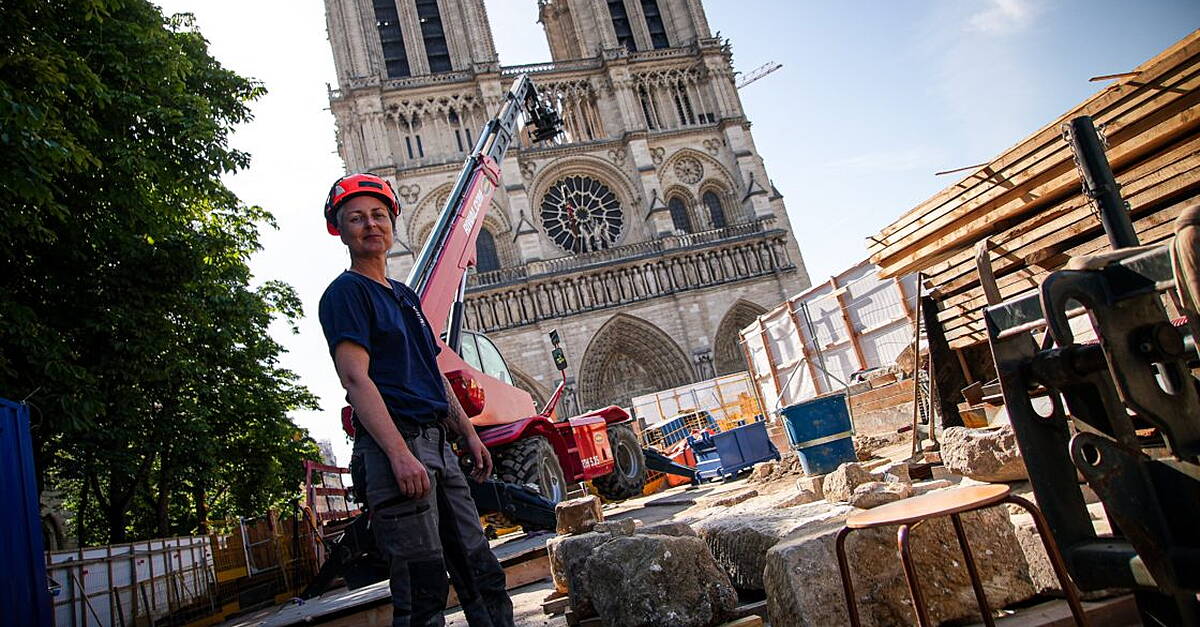
The result is an excavation site located just metres away from crowds of tourists waiting to enter the cathedral.
A section of the forecourt has been transformed into an open archaeological pit surrounded by barriers, where experts continue to uncover evidence of centuries of human activity.
Layers of History Beneath the Streets of Paris
Archaeologists say the excavation demonstrates how modern cities are often built directly on top of earlier civilizations.
The site is located on the Île de la Cité, the island in the Seine River where Paris was originally founded.
According to excavation leaders, traces of history begin appearing just 50 centimetres below the surface. Four metres underground, archaeologists are still discovering older and older layers of the city’s past.
The team has already identified medieval house cellars dating back to the period when Notre Dame was first constructed in 1163.
Beneath those structures are remnants from the Merovingian and Carolingian eras, which span roughly from the sixth to the tenth centuries.
Even deeper, researchers have uncovered evidence of a Roman settlement dating back to the fourth and fifth centuries, when Paris was known as Lutetia.
Experts estimate that nearly 20 centuries of history are compressed into just four metres of earth beneath the cathedral square.
Roman Coin and Mysterious Pottery Among Key Finds
The excavation has produced hundreds of artifacts, many of which are providing valuable clues about life in ancient Paris.
One of the most significant discoveries is a fourth-century coin bearing the image of Roman Emperor Constantine, who ruled during the early 300s AD.
Archaeologists say such coins are particularly important because they help establish the age of specific underground layers.
The excavation has also revealed a collection of medieval pottery fragments containing unusual reddish inscriptions painted on the interior surfaces.
Researchers have yet to determine the meaning of the markings, making them one of the most intriguing discoveries from the site.
Conservators working on the artifacts say the repeated appearance of the symbols across multiple pottery fragments suggests they may have served a specific purpose, though their significance remains unknown.
Medieval Latrines Become Archaeological Treasure Troves
Some of the most remarkable discoveries have emerged from what were once medieval waste pits.
These underground latrines also served as rubbish dumps, preserving everyday objects discarded by residents centuries ago.
Unlike many archaeological sites where artifacts are found broken or damaged, the soft organic material inside these pits helped protect fragile objects from destruction.
As a result, archaeologists have recovered complete ceramic jugs, cups and household vessels that remain largely intact despite being buried for hundreds of years.
Animal bones, broken tableware and other household items have also been recovered, offering a rare glimpse into daily life during medieval times.
Traces of Ancient Roman Paris
The Roman-era discoveries are generating particular excitement among researchers.
During the height of the Roman Empire, the settlement of Lutetia was centred primarily on Paris’ Left Bank.
As the empire declined, residents gradually moved to the more defensible Île de la Cité, where they constructed fortifications using materials salvaged from earlier Roman structures.
Evidence of this practice has been uncovered during the excavation.
Archaeologists discovered a Roman stone doorstep that had been removed from a larger building, transported elsewhere and later repurposed as paving material in a roadway.
Such findings help researchers understand how ancient communities adapted existing structures during periods of political and social change.
Artifacts Sent to Paris Archaeology Centre
Every object recovered from the excavation is transported to the city’s archaeology centre for further study, preservation and cataloguing.
Specialists carefully clean, analyse and document each discovery before determining its historical significance.
Experts say the ongoing work could reveal additional information about the evolution of Paris from a Roman settlement into one of Europe’s most influential medieval cities.
Search Continues for Evidence Predating Roman Paris
Despite the remarkable discoveries already made, archaeologists believe the site may contain even older secrets.
The team hopes to excavate deeper in search of evidence linked to the Gauls, the Celtic people who inhabited the region before Roman rule.
Finding traces of these early inhabitants could provide new insights into the origins of Paris and the communities that existed long before the construction of Notre Dame Cathedral.
New Notre Dame Square Expected by 2028
Once the archaeological work is completed, the area around Notre Dame will undergo a major transformation.
City planners envision a greener and more climate-resilient public space featuring approximately 160 new trees and water features designed to help cool the square during increasingly hot summers.
The project is part of Paris’ broader effort to adapt to climate change while preserving its historic landmarks.
A revamped visitor centre overlooking the Seine River is also planned as part of the redevelopment.
For now, however, the excavation continues to offer a rare opportunity to explore centuries of history hidden beneath one of the world’s most famous cathedrals, revealing that beneath modern Paris lies an even older city waiting to be rediscovered.