
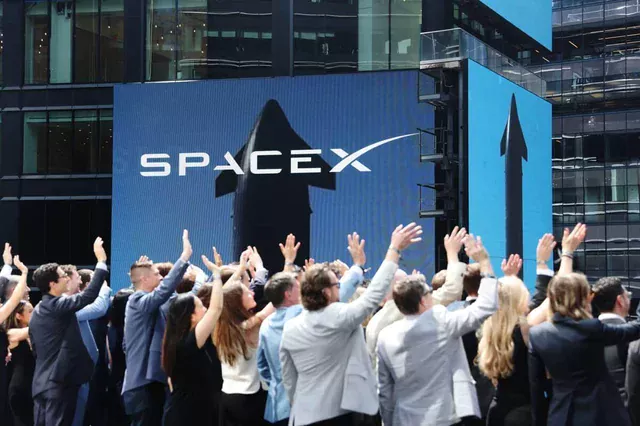


New York: SpaceX shares suffered their first decline since the company’s blockbuster initial public offering (IPO), ending a three-day rally that had propelled Elon Musk’s aerospace and artificial intelligence giant nearly 50% higher.
The stock fell around 5% on Wednesday following a volatile trading session that saw shares initially climb as much as 6% before reversing course and ending the day in negative territory.
The decline pushed SpaceX back below Amazon in terms of market capitalisation, making it the world’s sixth-largest publicly traded company with a valuation of approximately $2.5 trillion. Despite the pullback, the stock remains more than 42% above its IPO price of $135 per share.
Investors View Pullback as Normal After Massive Rally
Market participants largely viewed the decline as a healthy pause following one of the strongest IPO debuts in recent memory.
Michael Monaghan, Partner and Portfolio Manager at Founder Funds in Dallas, said the move does not yet signal a meaningful shift in investor sentiment.
“Long story short, I think this is just noise so far. If we were to see a big down day, I think that’d be a different discussion,” Monaghan said.
“If it really got hit more, we’d probably add,” he added, indicating confidence in the company’s long-term prospects.
Low Share Availability Driving Volatility
Analysts believe part of the stock’s dramatic price swings can be attributed to its limited public float.
Only around 4.2% of SpaceX’s total shares were available for trading at the time of its IPO, creating a situation where relatively small buying and selling volumes can trigger sharp price movements.
While the restricted supply has helped fuel the stock’s rapid rise, market experts warn that upcoming lock-up expirations could create additional selling pressure.
As insider restrictions begin to expire over the coming months, more shares may enter the market, potentially increasing volatility and weighing on the stock price.
Broader Market Weakness Added Pressure
SpaceX’s decline also coincided with a broader sell-off across US equity markets following the Federal Reserve’s latest policy announcement.
The Fed left interest rates unchanged but released projections showing policymakers remain divided over the future direction of monetary policy. The decision was the first under newly appointed Federal Reserve Chairman Kevin Warsh.
Following the announcement, traders increasingly priced in the possibility of an interest rate hike by October.
The broader market reacted negatively, with the S&P 500 declining 1.2%, while the technology-heavy Nasdaq 100 fell 1%.
Against that backdrop, SpaceX’s first down day appeared less dramatic than it might have otherwise seemed.
Retail Investors Continue to Pile Into SpaceX
Despite Wednesday’s pullback, retail investors remain highly enthusiastic about the stock.
According to data from Vanda Research, SpaceX has been the most-purchased stock by retail investors every trading day since its IPO.
Remarkably, buying activity in SpaceX has matched the combined retail inflows seen in several market giants, including Nvidia, Alphabet, Amazon, Meta Platforms, and major exchange-traded funds tracking the Nasdaq 100 and S&P 500.
At the same time, investors have been reducing exposure to another Elon Musk-linked company.
Vanda’s data showed approximately $61 million in net selling of Tesla shares during the same period.
“Perhaps we’re seeing a rotation from one Elon-linked trade into another, with SpaceX increasingly viewed as the cleaner AI and tech exposure,” Vanda Research noted.
IPO Performance Outpaces Most Tech Listings
Even after Wednesday’s decline, SpaceX remains on track to deliver one of the strongest post-IPO performances seen in the technology sector over the past decade and a half.
According to research from Truist Advisory Services, if current gains hold through the company’s first five trading days, SpaceX will comfortably outperform both the average and median one-week returns generated by 30 major US technology IPOs over the last 15 years.
Historical data cited by Truist shows that while 57% of large tech IPOs posted positive returns after one week, one month and three months, only 43% managed to maintain gains over six- and twelve-month periods.
The statistics highlight the challenge of sustaining early post-IPO momentum.
Michael Burry Watching From the Sidelines
Famed investor Michael Burry, known for predicting the 2008 financial crisis and portrayed in The Big Short, has also weighed in on SpaceX’s trading frenzy.
In a post published on Substack earlier this week, Burry said he had considered taking a bearish position against the company but ultimately decided against it.
According to Burry, put options on SpaceX — which profit if the stock falls — are currently too expensive to justify the trade.
As a result, he has chosen not to bet against the company for now.
Options Market Signals Growing Hedging Activity
Investor caution has nonetheless begun appearing in the options market.
Data showed that the ratio of put options to call options moved close to parity on Wednesday, indicating more traders are purchasing protection against a potential decline than they were earlier in the week.
More than 1.4 million SpaceX options contracts changed hands during the session, making it the third-most actively traded security in the US options market behind Tesla and Nvidia.
Although trading volume was down 24% from Tuesday’s record levels, investor interest remains exceptionally strong.
Index Inclusion Could Provide Another Catalyst
A major factor supporting bullish sentiment is the possibility of SpaceX being added to key stock market indices in the coming weeks.
Nasdaq recently modified its rules to allow exceptionally large newly listed companies to gain entry into its indices more quickly.
Under those rules, SpaceX will become eligible for inclusion in the Nasdaq-100 after completing 15 trading days.
Should the company be added, index funds and exchange-traded funds tracking the benchmark would be required to purchase shares, potentially creating significant additional demand.
However, inclusion in the S&P 500 will take considerably longer.
S&P Dow Jones Indices has decided not to accelerate entry rules for newly listed companies, meaning SpaceX will need to wait at least one year and satisfy existing profitability and public float requirements before becoming eligible.
Investors Eye Long-Term Potential
Market strategists believe the prospect of future index inclusion may encourage some investors to remain patient despite short-term volatility.
Shelby McFaddin, Portfolio Manager at Motley Fool Asset Management, said some investors may prefer to wait for passive index exposure rather than chase the stock after its rapid rise.
“It could play into the fact that some investors are saying, well, I’m not going to panic because if you’re able to then go ahead and just track that index with an investable instrument, you’re getting exposure,” McFaddin said.
For now, SpaceX remains one of the market’s most closely watched stocks, with investors balancing extraordinary growth expectations against the realities of post-IPO volatility and evolving monetary policy conditions.