
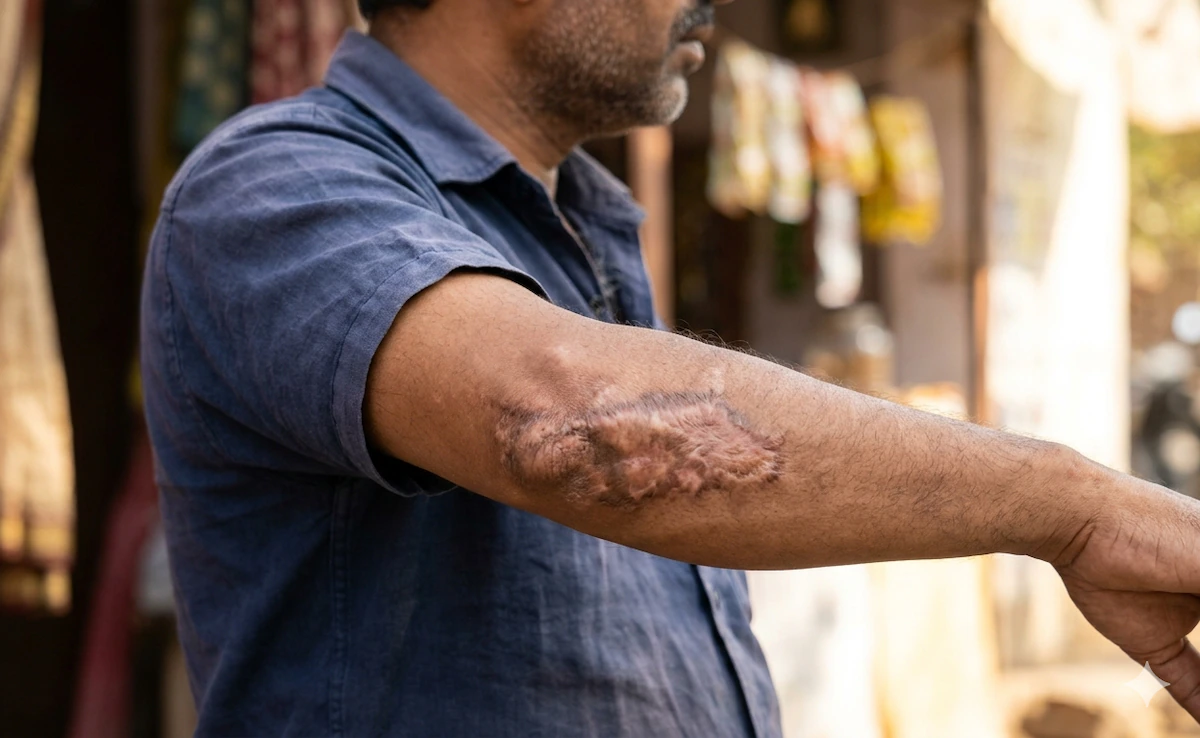


Human skin acts as the body’s first line of defence, but it also carries a long memory of trauma. While most burn wounds eventually heal and leave behind scars, some chronic burn scars can silently undergo cancerous transformation years — or even decades — later. This rare but dangerous condition is known as Marjolin’s ulcer.
Doctors say Marjolin’s ulcer develops in chronic wounds or scar tissue that has existed for a long time, most commonly after severe burns. In most cases, the cancer appears as an aggressive form of squamous cell carcinoma, a common skin cancer that becomes significantly more dangerous when it originates inside scar tissue.
Although the condition can also emerge from surgical scars, pressure sores, or chronic non-healing wounds, old burn injuries remain the most common trigger.
Why Can A Burn Scar Become Cancerous?
When the skin suffers a major burn, the body repairs the damage by forming scar tissue. However, scar tissue is structurally different from healthy skin. It contains fewer skin cells, reduced blood supply, and weakened immune activity, making it less capable of protecting itself from long-term cellular damage.
According to experts, chronic wounds and unstable scars often go through repeated cycles of breakdown and repair. This constant inflammation can gradually damage the DNA of skin cells, increasing the likelihood of mutations that lead to uncontrolled cell growth and eventually cancer.
Burned skin may also lose melanin and oil glands, both of which normally help shield healthy skin from environmental damage such as ultraviolet radiation. This makes scarred areas more vulnerable to secondary triggers over time.
Factors That Increase The Risk
Medical experts say several factors influence whether a burn scar develops into Marjolin’s ulcer.
Severity Of The Original Burn
Deep burns pose the highest risk. Superficial burns rarely become cancerous because they do not destroy the regenerative layers of the skin. Third-degree burns are considered particularly dangerous due to extensive tissue damage.
Location Of The Scar
Studies suggest the feet are the most common site for Marjolin’s ulcer. Constant movement and pressure on the legs and feet can repeatedly disrupt healing, increasing long-term irritation within the scar tissue.
The scalp is another high-risk area because of prolonged exposure to ultraviolet rays, which may further damage already weakened skin.
Weak Immune System
People with suppressed immune systems, including organ transplant recipients or patients taking immunosuppressive medication, are considered more vulnerable to developing the condition.
The Hidden Danger: A Long Latency Period
One of the most concerning aspects of Marjolin’s ulcer is how long it can take to appear.
Doctors say the cancer may develop anywhere between a few weeks and more than 50 years after the original injury. On average, it emerges around 30 to 35 years after the burn occurred.
This means someone who suffered severe burns in childhood or early adulthood may not experience symptoms until much later in life, often when the injury itself has long been forgotten.
Clinical data also suggests that younger patients generally experience a longer latency period, while people burned later in life may develop cancer more quickly.
Warning Signs That Should Never Be Ignored
Because the disease develops inside already damaged skin, early symptoms are often mistaken for routine irritation or scar-related discomfort.
Doctors advise seeking medical attention if any of the following symptoms appear in an old scar:
- A sore or ulcer that does not heal within three to four weeks
- A new lump or thickened area developing inside the scar
- Sudden pain, burning, or itching in a previously stable scar
- Rapid colour changes, especially uneven red, brown, or black patches
- Bleeding, cracking, or repeated breakdown of scar tissue
Marjolin’s ulcers typically begin as small non-healing ulcers that slowly enlarge over time. If left untreated, the cancer can spread to nearby lymph nodes and other organs.
Is Marjolin’s Ulcer Curable?
Experts say the disease can be treated successfully if detected early.
In its early stages, squamous cell carcinoma arising from burn scars can often be completely removed through surgery. However, outcomes become significantly worse once the cancer spreads.
According to clinical data, survival rates decline sharply over time, highlighting the importance of early diagnosis and treatment.
Prevention And Long-Term Care
Modern burn treatment focuses heavily on early skin grafting to close deep wounds quickly. Research shows that burns treated with proper grafting are far less likely to become cancerous compared to wounds left to heal naturally over long periods.
For people already living with old scars, doctors recommend protecting the area from repeated trauma and prolonged sun exposure. Keeping scars moisturised can also help prevent cracking and chronic irritation.
Conclusion
Most burn scars never develop into cancer. However, experts warn that large, deep, and long-standing scars — especially those exposed to repeated trauma or sunlight — carry a small but serious risk of turning into Marjolin’s ulcer.
Persistent irritation, pain, or non-healing wounds in old scars should never be ignored, as early medical attention can make a life-saving difference.
Inputs by Dr AB Prabhu, Additional Director, Plastic and Reconstructive Surgery, Fortis Hospital Mohali.