
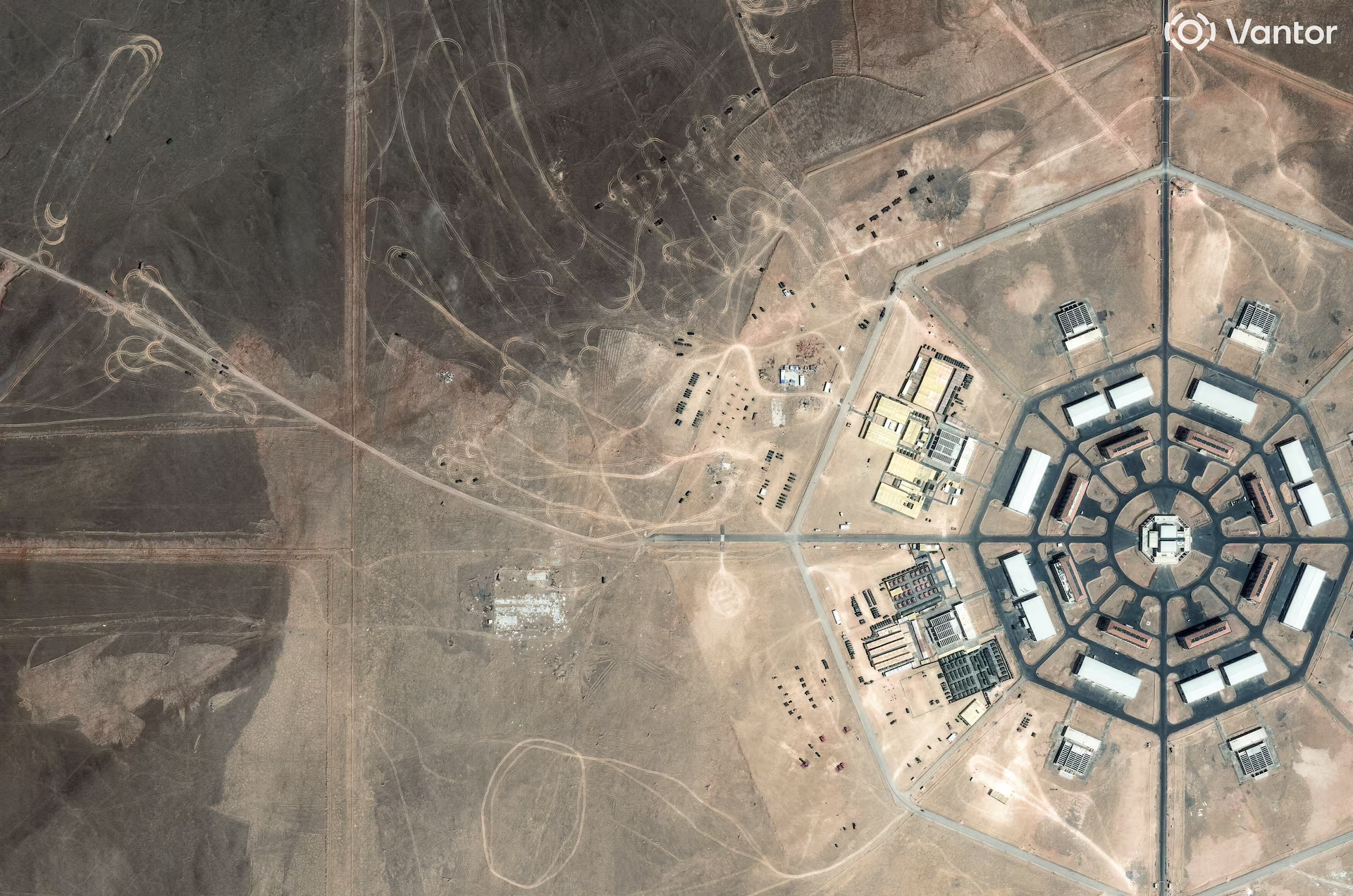


China is rapidly expanding a vast military infrastructure network across its remote northwestern desert region in what security analysts describe as a major effort to protect the country’s nuclear arsenal from a potential first strike by the United States.
According to a Reuters investigation based on satellite imagery, the construction is taking place in eastern Xinjiang near the Hami nuclear silo field, one of China’s key strategic missile locations housing some of its longest-range intercontinental ballistic missiles (ICBMs).
The images reportedly show more than 80 concrete launch pads, fortified bunkers, military communications systems and underground-linked facilities spread across thousands of square kilometres of desert terrain.
Security experts believe the infrastructure is intended to significantly strengthen China’s “second-strike capability” — the ability to launch nuclear retaliation even after sustaining an enemy nuclear attack.
Analysts Say China Is Expanding Strategic Nuclear Deterrence
Alexander Neill, adjunct fellow at the Hawaii-based Pacific Forum, told Reuters the scale of development points to a major transformation in China’s nuclear defence posture.
“We can see this infrastructure is being built on a grand scale, covering thousands of square kilometers of desert beyond the silo fields,” Neill said.
He added that depending on the final operational capabilities, the network could represent “a very considerable enhancement and diversification of China’s strategic nuclear deterrent.”
The findings come amid growing global concern over China’s rapid military modernisation under President Xi Jinping.
Satellite Images Show Octagon-Shaped Military Complexes
Reuters reported that satellite imagery also revealed two large octagon-shaped military complexes southwest of the Hami missile field.
The installations reportedly include:
- Housing blocks for military personnel
- Large vehicle storage and maintenance facilities
- Airfields and railheads
- Heavily fortified underground storage zones
- Camouflaged launch positions
- Temporary military structures
Recent satellite images from April and May allegedly showed military vehicle movement and ongoing construction activity around the complexes.
Analysts examining the imagery believe some of the launch pads may support:
- Mobile missile launcher systems
- Air defence batteries
- Electronic warfare infrastructure
Others suggested that underground conduits linking the sites could contain fibre-optic communication networks designed for secure military coordination during conflict situations.
“Extraordinary Effort”: Nuclear Experts React
Hans Kristensen, director of the Nuclear Information Project at the Federation of American Scientists, described the construction scale as unprecedented.
“I’ve never seen anything quite like it,” Kristensen told Reuters. “It’s an extraordinary effort.”
Experts say the vast infrastructure indicates China is moving beyond traditional silo-based deterrence and creating a more survivable and dispersed nuclear defence network.
China’s Nuclear Expansion Under Global Scrutiny
The developments come as China continues accelerating the modernisation of its strategic military capabilities.
According to the Pentagon’s latest assessment, China is expected to possess nearly 1,000 nuclear warheads by 2030, despite indications of a recent slowdown in warhead production.
China officially maintains a “no first use” nuclear policy, under which it says it would not initiate a nuclear strike.
However, some Western diplomats and defence analysts remain sceptical and argue Beijing could potentially use nuclear coercion during a future conflict involving Taiwan.
China’s Approach Differs From US And Russia
Reuters noted that China’s expanding desert defence system appears significantly different from the nuclear deterrence models used by the United States and Russia.
While Washington and Moscow rely heavily on hardened silos, submarine-based deterrence and silo quantity, China appears to be building an extensive defensive network combining:
- Missile silos
- Mobile launch capabilities
- Fortified infrastructure
- Air defence systems
- Underground communications
Analysts say this layered strategy could make China’s nuclear forces more difficult to neutralise during a potential conflict.
Growing Strategic Competition
The report emerges amid rising geopolitical tensions between China and the United States over Taiwan, the South China Sea and military influence in the Indo-Pacific region.
Beijing has increasingly invested in long-range missile systems, naval expansion and strategic defence infrastructure as part of its broader military modernisation goals.
The satellite imagery findings are likely to intensify international discussions around nuclear stability, arms competition and strategic deterrence in Asia.