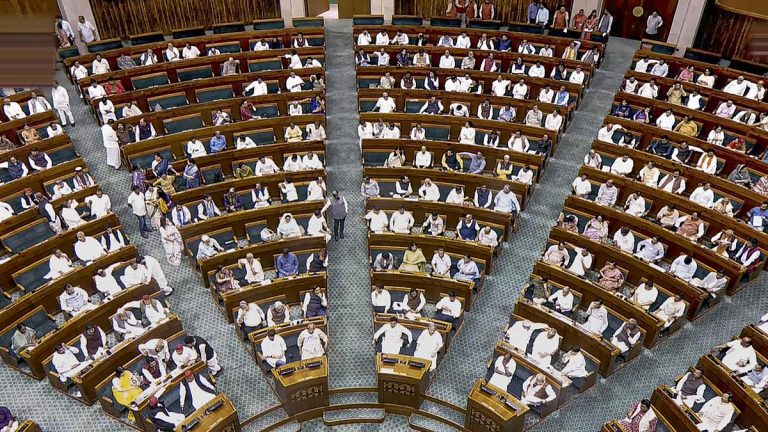
The Lok Sabha witnessed a landmark legislative showdown during a three-day special session On Friday, April 17, 2026. The 131st Constitution Amendment Bill, which aimed to expand the Lok Sabha’s size to 850 seats and fast-track the 33% women’s reservation, failed to secure the mandatory two-thirds majority.
The Numbers: A United Opposition
Despite the government’s efforts to rally support, the final tally fell short of the constitutional requirement for amendments.
Total Votes: 528
Ayes (In Favor): 298
Noes (Against): 230
The Result: While the government had a simple majority, it lacked the 352 votes (two-thirds of those present and voting) needed for a constitutional amendment.
Why the Bill Failed: The Delimitation Deadlock
The defeat was rooted in a fundamental disagreement over delimitation—the process of redrawing constituency boundaries.
Government’s “50% Increase” Offer: In a dramatic last-minute intervention, Home Minister Amit Shah offered to include a written guarantee that every state would see a proportional 50% rise in seats. This was intended to soothe fears in Southern states (like Tamil Nadu) that their parliamentary influence would shrink compared to more populous Northern states.
The Opposition’s Trust Deficit: Led by Rahul Gandhi and regional heavyweights like Akhilesh Yadav and MK Stalin, the Opposition rejected the offer. They argued that the bill was a “Trojan horse” designed to alter India’s political structure and insisted that women’s reservation should be implemented immediately within the current Lok Sabha strength, without being tied to a new census or delimitation.
Caste Census Demand: The Opposition also maintained that any women’s quota must include a specific “quota within quota” for OBC women, which they argue can only be determined after a nationwide caste census.
Immediate Legislative Aftermath
Following the defeat of the main amendment, the government moved swiftly to contain the fallout:
Bills Withdrawn: Two related bills—one regarding the use of the 2011 Census for delimitation and another applying changes to Union Territories—were abruptly withdrawn.
The 2023 Act Status: The Nari Shakti Vandan Adhiniyam (2023) remains valid law. However, its implementation remains legally tethered to a post-census delimitation exercise, which is currently in a state of political limbo.
Reaction from the Leaders
“This insult to Nari Shakti will not stop here; it will travel far and wide. The opposition will have to face the ‘wrath of women’ at every level.” — Amit Shah, Union Home Minister
“We have defeated this attack on the Constitution. This was not about women’s reservation, but a way to change India’s political structure.” — Rahul Gandhi, Leader of the Opposition
What’s Next?
The political battle now moves from the floor of the House to the campaign trail:
Special Session Finale: Both Houses will reconvene for a final sitting on Saturday, April 18, 2026.
Cabinet Meeting: Prime Minister Modi has called for an emergency cabinet meeting on Saturday morning to discuss the government’s next move.
Electoral Impact: With high-stakes elections ongoing in Tamil Nadu and West Bengal, the NDA has already begun nationwide protests, labeling the Opposition “anti-women,” while the Opposition celebrates the result as a “victory for federalism.”