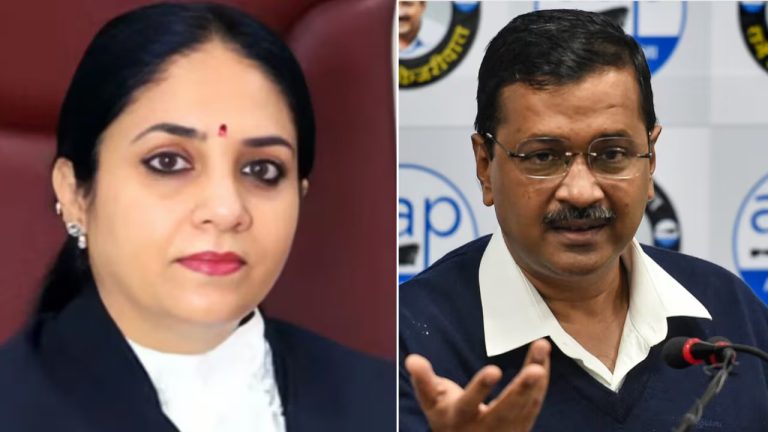
New Delhi: The Delhi High Court on Thursday initiated contempt proceedings against Aam Aadmi Party chief Arvind Kejriwal and several senior party leaders over what Justice Swarana Kanta Sharma described as a coordinated online campaign aimed at maligning the judiciary during hearings in the Delhi excise policy case.
At the same time, Justice Sharma announced that the excise policy matter involving Kejriwal and other AAP leaders would now be transferred to another bench. She clarified that the decision should not be interpreted as a recusal, but rather as an act of “judicial discipline” after initiating contempt proceedings in the matter.
“For a judge who is being targeted, it is a very lonely battle… This is not recusal. This is judicial discipline,” Justice Sharma observed in court.
The judge said “extremely vilifying, extremely contemptuous, and defamatory material” was being circulated online against her and her family members by the respondents, amounting to an attack on the institution of the judiciary itself.
According to the court, a “parallel narrative” was allegedly being created outside the courtroom through social media campaigns while the hearings in the liquor policy case were underway.
“A coordinated campaign was being carried out by contemnors armed with political powers,” the judge said, adding that edited videos and defamatory content involving her family members were circulated online in an attempt to intimidate both her and the judiciary.
Also Read – Delhi High Court Judge Transfers Arvind Kejriwal Excise Policy Case
Justice Sharma said she had two options in response to the alleged campaign — either be intimidated or initiate contempt proceedings.
“I have chosen to initiate contempt. Arvind Kejriwal cannot intimidate me,” she remarked.
The contempt proceedings have been initiated not only against Kejriwal but also against senior AAP leaders including Manish Sisodia, Sanjay Singh, Saurabh Bharadwaj, Durgesh Pathak, Vinay Mishra and Devesh Vishwakarma.
The judge also indicated that action could extend to certain YouTubers and social media accounts allegedly involved in amplifying edited videos and defamatory material linked to the case.
The controversy erupted after Kejriwal questioned Justice Sharma’s impartiality and sought her recusal from hearing matters related to the Delhi liquor policy case. The AAP chief had alleged bias, citing the judge’s alleged participation in events associated with the RSS. Justice Sharma had rejected the recusal plea earlier, stating there was no material to support claims of prejudice.
Following the refusal, Kejriwal publicly announced that he would no longer appear before the judge in the excise policy case.
In a post shared on X, the former Delhi Chief Minister said, “My hope of receiving justice from Justice Swarnkanta Sharma Ji has been shattered… Listening to the voice of my conscience, adhering to the principles of Gandhi Ji, and with the spirit of Satyagraha, I have decided that I will not appear before her in this case and will not present any arguments either.”
Justice Sharma, while addressing the court on Thursday, said judges are trained to accept criticism and dissent, but added that silence cannot always be equated with judicial restraint.
“The robe worn by a judge demands calmness. However, sometimes remaining silent is not judicial restraint. The moment has arrived today,” she said.
She further stressed that the judiciary survives not through power but through public confidence, and any attempt to weaken that trust through coordinated attacks constitutes serious contempt.
The Delhi excise policy case has remained one of the most politically sensitive legal battles involving AAP leaders, with multiple investigations by central agencies into alleged irregularities in the now-scrapped liquor policy.