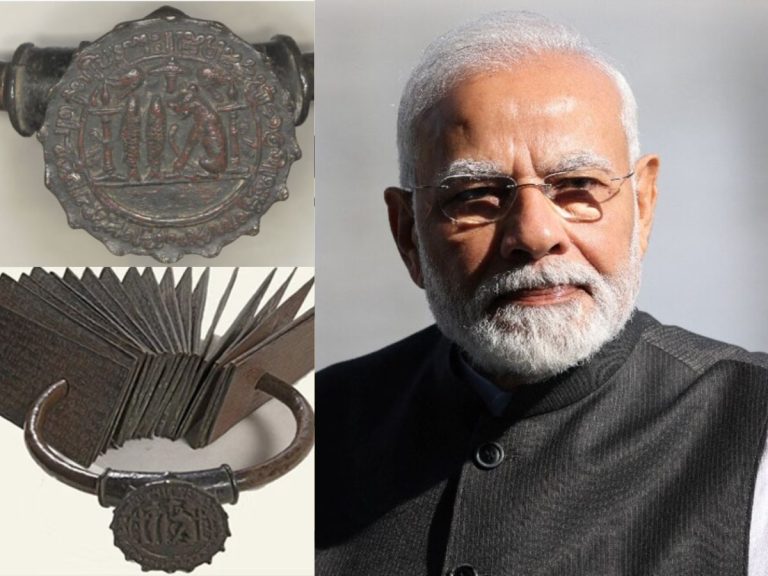
In a significant cultural and diplomatic development, the Netherlands has officially returned a rare set of 11th-century Chola-era copper plates to India during Prime Minister Narendra Modi’s visit to the European nation.
The artefacts, popularly known as the “Leiden Plates” in Europe, are regarded as some of the most historically important surviving records from the Chola dynasty. India had been pursuing their return since 2012, making the handover the culmination of more than a decade of diplomatic engagement between the two countries.
PM Modi arrived in the Netherlands on Friday after visiting the United Arab Emirates as part of his ongoing five-country tour, which also includes stops in Sweden, Norway and Italy.
Sharing the news on social media platform X, Modi described the return of the copper plates as “a joyous moment for every Indian.”
“A joyous moment for every Indian! Chola Copper Plates dating back to the 11th Century will be repatriated to India from the Netherlands,” the Prime Minister wrote after attending the handover ceremony alongside Dutch Prime Minister Rob Jetten.
A joyous moment for every Indian!
— Narendra Modi (@narendramodi) May 16, 2026
Chola Copper Plates dating back to the 11th Century will be repatriated to India from the Netherlands. Took part in the ceremony for the same in the presence of Prime Minister Rob Jetten.
The Chola Copper Plates are a set of 21 large plates… pic.twitter.com/Zwu0QFc2ZJ
Rare Chola-Era Records Return Home After Centuries
The copper plates date back to the reign of Rajaraja Chola I, one of the greatest rulers of the Chola empire, who ruled between 985 and 1014 CE.
Historians consider the plates among the most valuable pieces of Tamil heritage preserved outside India. The collection consists of 21 copper plates weighing nearly 30 kilograms, bound together by a bronze ring engraved with the royal Chola seal.
The inscriptions are written in both Sanskrit and Tamil and contain detailed records of grants made to a Buddhist monastery in Nagapattinam. Scholars believe the inscriptions provide rare insights into the Chola empire’s maritime trade links with Southeast Asia as well as the period’s religious harmony and cultural exchange.
According to historical accounts, Rajaraja Chola I initially issued the orders verbally, which were first documented on palm leaves. His son, Rajendra Chola I, later had the records permanently engraved on copper plates to preserve them for future generations. The bronze binding ring itself bears Rajendra Chola’s emblem.
How The Leiden Plates Reached The Netherlands
The copper plates were taken to the Netherlands in the 18th century by Florentius Camper, who was associated with a Christian mission in India during the time when Nagapattinam was under Dutch colonial control.
For decades, the artefacts remained in Dutch custody and were stored in secure facilities. Access was largely restricted to historians, researchers and Tamil epigraphists studying South Indian history.
Over time, the Leiden Plates also became widely recognised among the public due to references in Ponniyin Selvan, the celebrated Tamil historical novel that brought renewed attention to the Chola empire and its rulers.
India’s Long Push For Repatriation
India formally sought the return of the artefacts in 2012. The country’s claim later received support during the 24th session of UNESCO’s Intergovernmental Committee on Return and Restitution, which acknowledged India as the rightful country of origin.
The committee encouraged discussions between both governments regarding the return of the plates, eventually paving the way for the current handover.
Officials described the restitution as not just a diplomatic gesture, but also a powerful symbol of growing cultural cooperation between India and the Netherlands.
Cultural Diplomacy Gains Momentum
The return of the Leiden Plates adds to India’s broader efforts to bring back historically significant artefacts taken abroad during colonial periods.
In recent years, several countries including the United States, Australia and the United Kingdom have returned ancient Indian idols, sculptures and manuscripts after diplomatic negotiations and provenance investigations.
Experts say the repatriation of the Chola copper plates is particularly significant because of their historical value and direct connection to one of India’s most influential dynasties.
The return is also expected to strengthen cultural exchanges between India and the Netherlands as both countries deepen cooperation across trade, technology, heritage and diplomacy.