The Supreme Court on Monday reiterated that “bail is the rule and jail is the exception” even in cases filed under the stringent Unlawful Activities (Prevention) Act (UAPA), while granting bail to a Jammu and Kashmir man accused in a narco-terror case.
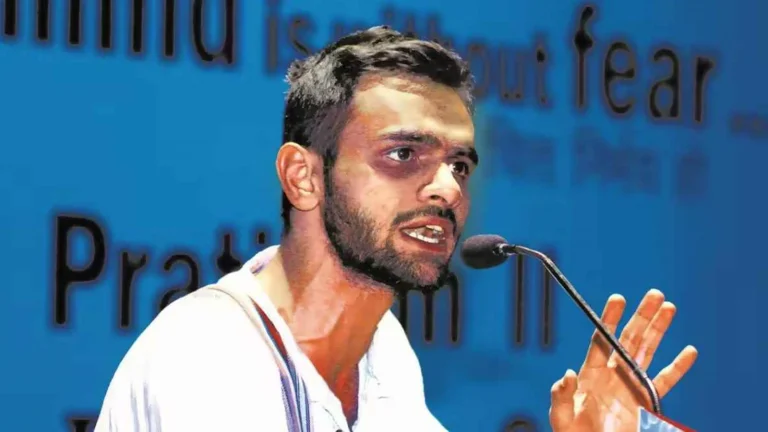
The observations have once again drawn attention to the ongoing legal battle involving Umar Khalid and Sharjeel Imam, both jailed in connection with the 2020 Delhi riots conspiracy case.
Supreme Court questions prolonged incarceration under UAPA
A bench of Justices BV Nagarathna and Ujjal Bhuyan granted bail to Syed Iftikhar Andrabi, accused in a case involving alleged heroin smuggling and terror financing linked to Lashkar-e-Taiba.
The Court stressed that strict bail provisions under Section 43D(5) of the UAPA cannot justify endless imprisonment without trial. It observed that constitutional protections under Articles 21 and 22, including personal liberty and protection against arbitrary detention, continue to apply even in anti-terror cases.
The bench stated that courts must balance national security concerns with individual rights and clarified that denial of bail should depend on the facts and seriousness of each case.
What is Section 43D(5) of the UAPA?
Section 43D(5) is considered one of the toughest bail provisions in Indian law. Under this clause, courts can deny bail if accusations against the accused appear “prima facie true.”
In practice, critics argue that this provision has often resulted in accused persons spending years in jail before their trials are completed.
The Supreme Court has now clarified that such restrictions cannot override constitutional safeguards indefinitely, especially in cases involving prolonged delays.
Why the KA Najeeb judgment matters
The bench relied heavily on the landmark 2021 ruling in Union of India vs KA Najeeb judgment, where the Supreme Court held that constitutional courts can grant bail in UAPA cases if trials are excessively delayed and incarceration becomes punitive.
The Court reaffirmed that the KA Najeeb judgment remains binding law and cannot be ignored by lower courts.
Gulfisha Fatima ruling comes under scrutiny
The Supreme Court also expressed disapproval of the reasoning used in the Gulfisha Fatima bail ruling, which had earlier been cited in denying bail to Umar Khalid and Sharjeel Imam.
According to the bench, the earlier ruling did not properly apply the principles established in the KA Najeeb judgment regarding prolonged incarceration and delayed trials.
Legal observers believe these latest remarks could influence future UAPA bail hearings, especially in high-profile cases where accused individuals have remained in custody for several years without trial completion.
Background of the Andrabi case
The National Investigation Agency alleges that Andrabi was part of a cross-border heroin smuggling network operating in Jammu and Kashmir. Investigators claim proceeds from narcotics sales were used to fund terror activities linked to Lashkar-e-Taiba and Hizbul Mujahideen.
The case was registered in 2020 under provisions of the UAPA and the Indian Penal Code.