
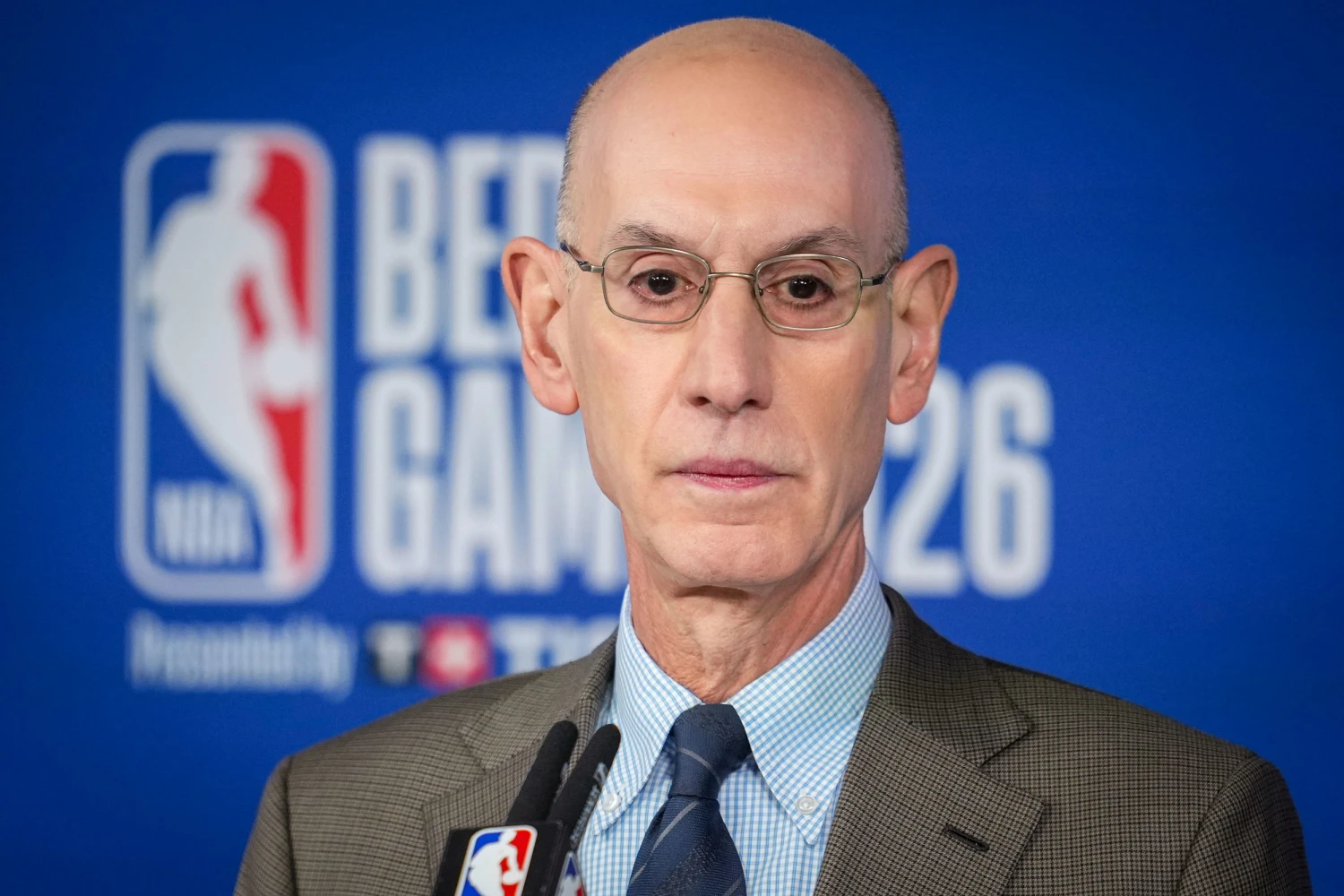


In what marks one of the most significant technological shifts in modern professional sports officiating, NBA Commissioner Adam Silver has revealed that the league is preparing to implement an artificial intelligence-powered automated review system. The cutting-edge system will assume total control over out-of-bounds possession rulings, aiming to drastically reduce human error and eliminate agonizingly slow replay delays that plague the final minutes of close basketball games.
Appearing on The Pat McAfee Show on Wednesday night, Silver laid out a futuristic vision where camera-based tracking networks and complex AI algorithms will determine which team touched the ball last before it crossed the boundary lines. The automation is intended to function smoothly and instantly in the background, entirely removing objective binary decisions from the human refereeing crew on the floor.
The Commissioner’s Vision: “We’re going to move to a system like that where that whole category of calls will be automatic, where it’s going to be Laker ball, Knick ball, whatever it is, Thunder ball,” Silver told host Pat McAfee. “Those calls will be done by an AI-automated system with cameras lined around the court, and it’ll take all of those so-called objective calls out of the hands of the referees. It’ll be instantaneous, it’ll be automatic. Just play on.”
Streamlining the Flow: Eliminating the Coach’s Challenge Drag
The primary catalyst behind this massive technical leap is game flow. Under current NBA rules, out-of-bounds disputes frequently result in referees huddling around a tiny courtside monitor for minutes at a time, or coaches using their precious “Coach’s Challenge” to trigger a video review. These constant breaks kill stadium momentum and frustrate television audiences during the most exciting segments of a broadcast.
Silver pointed out that by introducing an electronic system mirroring tennis’s Hawk-Eye line-calling or Major League Baseball’s (MLB) automated balls-and-strikes system, the league can keep the action moving without interruption. “Let’s go, Spurs inbound, and you move on,” Silver explained during his appearance. “You won’t have to deal with challenges on those calls anymore.”
The Human Element: Why Referees are Staying for Fouls
While artificial intelligence will soon rule the baseline, Silver emphasized that human referees are nowhere near extinction. The automated camera tracking system will strictly handle entirely objective, black-and-white rules. Subjective areas of basketball officiating—such as tracking defensive positioning, illegal screens, and evaluating physical contact for fouls will remain firmly in the hands of the on-court officials.
“There’s often contact on every play,” Silver elaborated, defending the complex nature of basketball officiating. “It doesn’t mean there’s a foul, and they’re trying to measure whether that contact is impeding the player, how hard that contact is it’s something that can’t just be done on camera.”
Silver stoutly defended the league’s current refereeing roster, calling their overall performance standards “incredible” while acknowledging the league must continuously innovate to support them.
The discussion wrapped up with a deep dive into “flopping” an issue that continues to split public opinion across the NBA community. Silver drew a sharp line between a player smartly “selling” a legitimate foul and a malicious flop designed to deceive the crew. “I think sometimes, even as I sit in the stands at games, players may be falling down, players may be reacting to a call. But then, to me, if they’re not fooling the referees, it’s like, ‘OK, the players are taught to sell calls these days.’”