
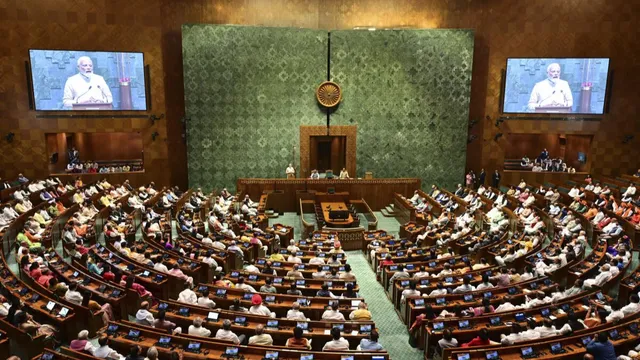


The Delimitation Bill 2026, introduced in the Lok Sabha by Union Law Minister Arjun Ram Meghwal, has sparked significant political interest due to its specific focus on Pakistan-occupied Kashmir (PoK). While the bill primarily sets the stage for the Nari Shakti Vandan Adhiniyam (Women’s Reservation Act), its clauses regarding PoK reaffirm India’s constitutional stance on the territory.
Key Provisions for Pak-occupied-Kashmir
The bill outlines a legal framework for future governance and representation in the region:
- Future Delimitation Power: The bill empowers the Election Commission of India (ECI) to conduct the delimitation of constituencies in PoK once the region returns to Indian control.
- Reserved Legislative Seats: Currently, the Jammu and Kashmir Legislative Assembly maintains 24 vacant seats designated for PoK. No elections are held for these seats at present, as they represent territory under Pakistani occupation.
- Constitutional Reaffirmation: The move is a formal legal reinforcement of India’s claim that PoK is an integral part of the country, based on the 1947 Instrument of Accession signed by Maharaja Hari Singh.
The Broader Legislative Context
The Delimitation Bill is one of three key pieces of legislation currently under consideration:
- Constitution (131st Amendment) Bill, 2026: Essential for implementing women’s reservation.
- The Delimitation Bill, 2026: Focused on the readjustment of seats in the Lok Sabha and State Assemblies.
- Union Territories Law (Amendment) Bill: Addressing administrative changes in UTs.
Political Significance
The inclusion of PoK in the bill is seen as a “dream of every Indian,” according to BJP leader Boora Narsaiah, who emphasized that the region belongs to India “legally, constitutionally, and morally.” This follows the 1994 unanimous Parliamentary resolution calling for the vacation of the region by Pakistan.
Voting on these bills is scheduled for 4:00 PM today, April 17, 2026, in the Lok Sabha.