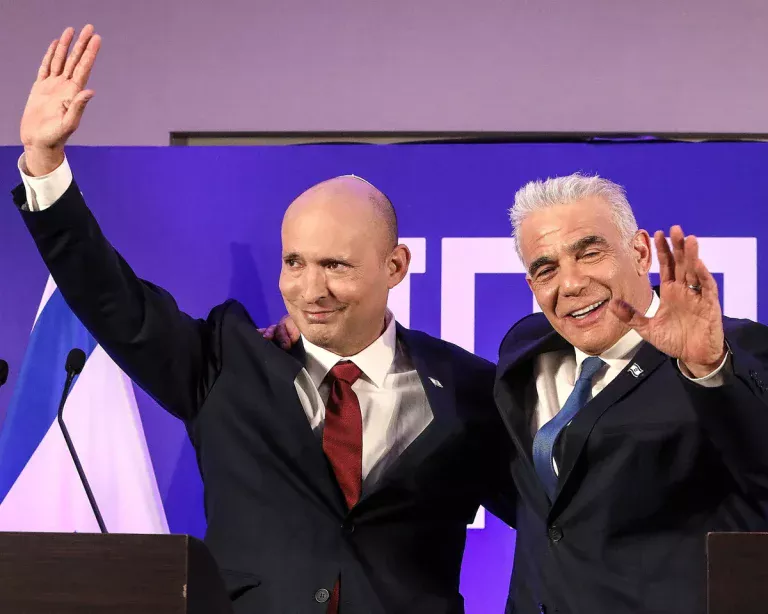
Jerusalem: Two major political rivals of Israeli Prime Minister Benjamin Netanyahu have announced a joint alliance ahead of upcoming elections, aiming to challenge his coalition government with a unified political front.
Right-wing leader Naftali Bennett and centrist politician Yair Lapid revealed plans to form a new political party named “BeYachad” — meaning “together” in Hebrew — signalling a significant shift in Israel’s opposition landscape.
While the alliance is expected to focus heavily on domestic issues, particularly debates over military conscription for the ultra-Orthodox, early signals suggest that their foreign and security policies may closely resemble those of Netanyahu’s current government.
‘BeYachad’ Alliance Takes Aim at Netanyahu Government
The formation of the BeYachad alliance is widely seen as a strategic attempt to consolidate opposition support against Netanyahu, who currently heads what many analysts describe as the most right-wing government in Israel’s history.
Although the new party has yet to publish a detailed policy platform, early comments from Bennett and Lapid indicate their primary campaign themes will include:
- Reforming domestic policies
- Addressing military service requirements
- Strengthening governance reforms
- Challenging Netanyahu’s leadership record
However, on critical regional security matters — particularly conflicts involving Iran, Gaza and Lebanon — their positions are expected to remain firm and largely aligned with existing Israeli security doctrine.
Strong Support for Military Action Against Iran
Both Bennett and Lapid have openly supported Israel’s military campaign against Iran, which involved joint operations with the United States.
At the start of Israel’s aerial strikes, Lapid described the campaign as:
“A just war against evil.”
Despite backing the war effort, the two leaders have criticised Netanyahu for what they consider incomplete strategic results, particularly the failure to overthrow Iran’s clerical leadership.
Notably, neither Bennett nor Lapid has publicly called for renewed fighting since an April 8 ceasefire halted missile exchanges between Israel and Iran.
Sources close to the new alliance described both leaders as “hawkish” but pragmatic, suggesting they support diplomacy following military action to secure long-term strategic goals.
Firm Position on Lebanon and Hezbollah
On the northern front, Bennett and Lapid have supported Israeli military operations in Lebanon, particularly against Iran-backed militant group Hezbollah.
Before Israel launched its ground operations in southern Lebanon earlier this year, Lapid emphasised that Israel must take “whatever steps were necessary” to safeguard its citizens.
After a ceasefire announced on April 17, both leaders expressed scepticism about its effectiveness.
Bennett warned that Hezbollah’s rebuilding efforts in southern Lebanon could trigger another round of fighting, stating:
“One can already count backwards towards the next round.”
Lapid also argued that long-term security requires the permanent removal of threats to northern Israel.
Criticism of Netanyahu’s Gaza Strategy
The ongoing conflict in Gaza Strip remains another key issue shaping Israel’s political debate.
Both Bennett and Lapid have criticised Netanyahu’s handling of the war following the October 7, 2023 attack carried out by Hamas.
Lapid accused the government of producing the “worst possible outcome”, claiming that Hamas still retains tens of thousands of fighters despite Israel’s prolonged military campaign.
Bennett also criticised humanitarian policy decisions, particularly the resumption of aid deliveries after months of restrictions in 2025.
Meanwhile, Netanyahu has defended the military campaign as successful and has suggested the possibility of resuming large-scale operations if Hamas refuses to disarm under a U.S.-backed framework.
Palestinian Statehood Remains a Divisive Issue
Public opinion surveys in Israel show widespread opposition to establishing an independent Palestinian state in territories including the West Bank, Gaza, and East Jerusalem.
Netanyahu strongly opposes Palestinian statehood and has accelerated settlement expansion in the West Bank.
Lapid, however, previously supported a two-state solution, stating in 2022 that it represented the best path toward peace.
In contrast, Bennett has rejected the idea, arguing that previous territorial concessions led to violence.
In a televised interview, Bennett said:
“Every time we gave the Palestinians a piece of land… they turned it into a terror state.”
Despite differing views on long-term solutions, all three leaders — Netanyahu, Bennett and Lapid — have publicly condemned settler violence against Palestinians, even as such incidents have reportedly increased in recent years.
What This Alliance Means for Israel’s Political Future
The creation of the BeYachad alliance signals a major shift ahead of Israel’s next election, potentially reshaping the country’s political balance.
While the partnership aims to remove Netanyahu from power, analysts believe Israel’s core security and foreign policies may remain largely unchanged, regardless of which coalition wins.
With ongoing tensions across multiple fronts — including Iran, Lebanon and Gaza — security issues are expected to remain at the centre of Israel’s political debate in the months ahead.