
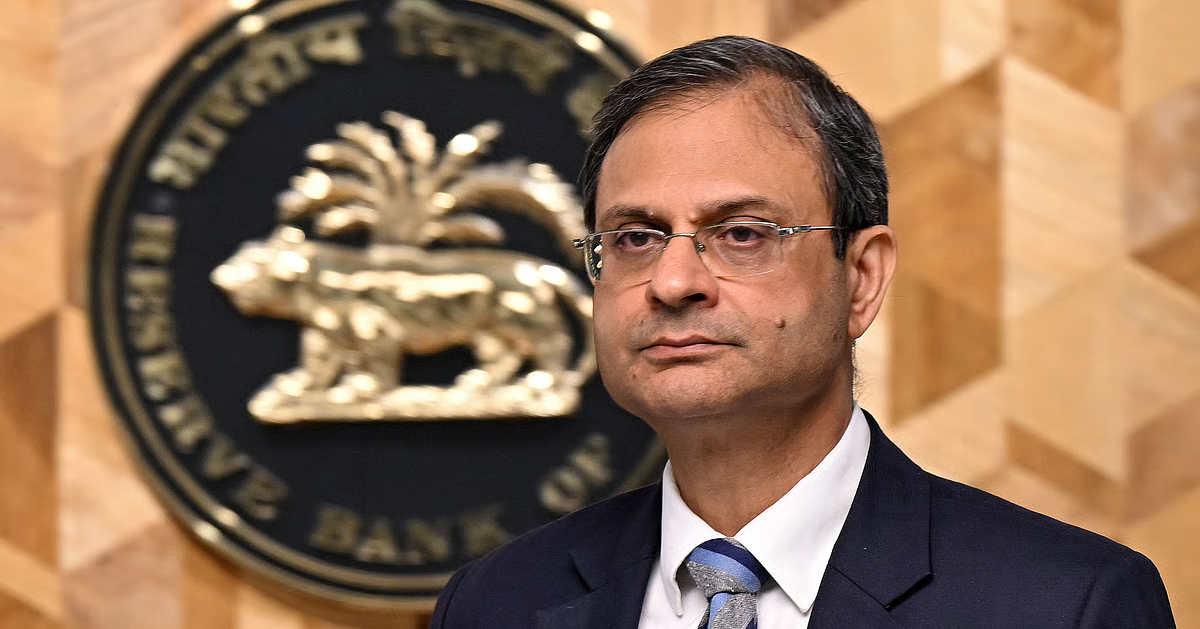

 has decided to keep the repo rate unchanged at 5.25 percent in its June 2026 monetary policy review)
The Reserve Bank of India (RBI) has decided to keep the repo rate unchanged at 5.25 percent in its June 2026 monetary policy review, signaling a cautious approach as policymakers navigate global uncertainties, currency pressures, and evolving domestic economic conditions. The decision was announced by RBI Governor Sanjay Malhotra following the latest meeting of the Monetary Policy Committee (MPC).
MPC Votes to Hold Rates Steady
The six-member MPC unanimously voted to leave the benchmark repo rate unchanged while retaining its “neutral” policy stance. The move was largely in line with market expectations as the central bank balances the need to support growth while remaining vigilant about inflationary risks and external challenges.
The repo rate, which determines the rate at which banks borrow from the RBI, remains at 5.25 percent after a cumulative reduction of 125 basis points since February 2025.
Why RBI Chose Caution
The central bank’s decision comes at a time of heightened global uncertainty. Ongoing geopolitical tensions, volatile commodity prices, and currency fluctuations continue to pose challenges for emerging economies, including India.
The Indian rupee has faced significant pressure in recent months, touching record lows against the US dollar. Maintaining policy stability allows the RBI to assess how these external developments evolve before making further adjustments to interest rates.
Growth Forecast Revised Lower
Alongside its policy decision, the RBI revised its GDP growth forecast for FY2026-27 downward. The central bank now expects the Indian economy to grow by around 6.6 percent during the current financial year, compared to its earlier projection of 6.9 percent.
The revision reflects concerns over global economic conditions, trade uncertainties, and the potential impact of external shocks on domestic demand and investment activity.
What It Means for Borrowers
For borrowers, the status quo means lending rates are unlikely to witness any immediate changes. Home loan, auto loan, and personal loan borrowers can expect existing interest rate structures to remain largely stable in the near term.
Banks may continue to evaluate their lending rates based on liquidity conditions and funding costs, but the RBI’s decision provides short-term certainty for borrowers.
Impact on Depositors
For depositors, stable policy rates suggest that fixed deposit rates are also likely to remain broadly unchanged. Savers may continue to benefit from relatively attractive deposit rates compared to the ultra-low interest rate environment seen in previous years.
Stock Markets React Positively
Indian equity markets responded positively to the announcement. Investors welcomed the RBI’s balanced approach, which signals support for economic stability without introducing unexpected policy surprises.
The benchmark Sensex and Nifty indices gained after the announcement, reflecting confidence in the central bank’s measured stance amid challenging global conditions.
Focus Shifts to Economic Data
Attention now turns to upcoming economic indicators, particularly GDP growth data and inflation trends. These numbers will provide further insight into the strength of the domestic economy and could influence future policy decisions.
The RBI has indicated that it will continue to monitor both domestic and international developments closely before making any changes to interest rates.
What Lies Ahead?
By maintaining a neutral stance, the RBI has kept its options open for future meetings. Depending on inflation, growth trends, and global developments, the central bank could either maintain current rates for longer or consider adjustments if economic conditions warrant action.
For now, the message from the RBI is clear: stability and caution remain the priority as India navigates an increasingly uncertain global economic environment.