
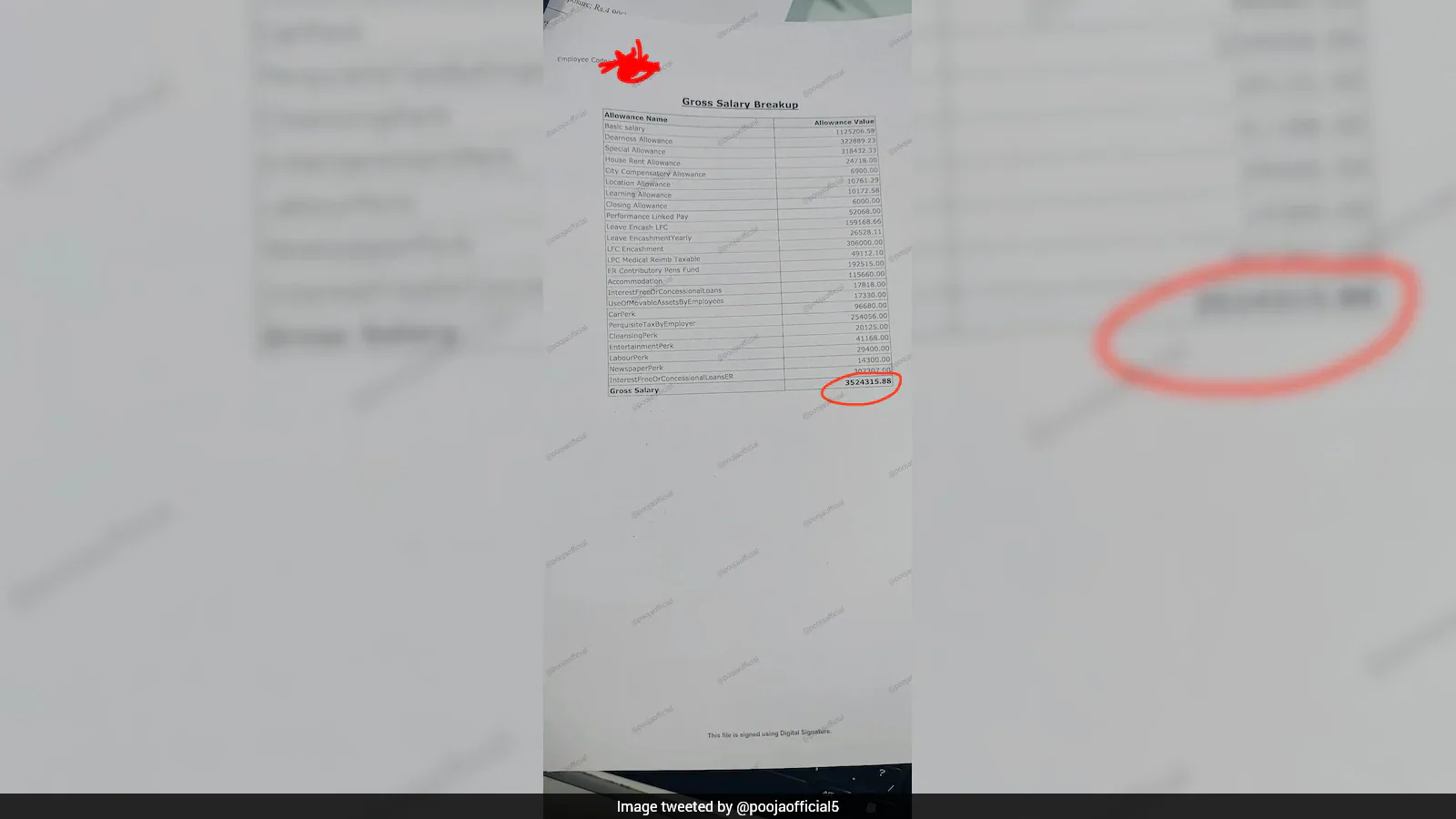


A State Bank of India (SBI) manager’s Form 16 showing an annual gross salary of Rs 35.24 lakh has gone viral on social media, triggering a widespread debate over the difference between gross salary and actual take-home income.
The document, shared on X, reportedly belongs to an SBI employee who joined the bank as a Probationary Officer (PO) eight years ago and has since been promoted to the position of Scale 3 Manager.
According to the Form 16 for FY 2025-26, the manager’s gross annual salary stood at Rs 35,24,315.88, a figure that surprised many users and sparked discussions about compensation in public sector banks.
Viral Post Explains Why Gross Salary Can Be Misleading
The user who shared the salary details clarified that the amount reflected in the Form 16 should not be mistaken for the employee’s regular monthly earnings.
“People often say that SBI employees have a ‘settled life’ but this Scale 3 Manager’s salary slip might completely change your perspective,” the post read.
The post further explained that the gross salary includes several one-time or infrequent benefits, which significantly increase the annual figure.
“At first glance, the figure looks huge. But the reality is quite different. The gross salary includes LFC Encashment and Leave Encashment, which are one-time benefits received only once every four years, not part of the regular monthly salary,” the post added.
These payments, such as Leave Fare Concession (LFC) encashment and leave encashment, are not recurring monthly components but are reflected in the annual tax statement.
Deductions Further Reduce Monthly Income
The post also highlighted that the employee’s monthly salary is considerably lower after mandatory deductions and financial commitments.
According to the explanation, deductions include:
- Income Tax
- National Pension System (NPS) contributions
- Employees’ Provident Fund (EPF)
- Home loan EMI
- Car loan repayment
- Two-wheeler loan repayment
As a result, the amount credited to the manager’s bank account every month is substantially lower than the gross annual salary shown in Form 16.
Social Media Divided Over Salary Figures
The post quickly gained traction, with users debating whether gross salary figures provide an accurate picture of an employee’s earnings.
One user wrote:
“Agreed, Rs 35 lakh gross looks great but includes four-yearly encashments. After tax, NPS, PF and loans, monthly take-home is far lower. Common myth about bank officers’ settled life.”
Another user pointed out that gross salary alone can be misleading.
“Looking only at Form 16 without considering taxes, deductions, one-time benefits and loan repayments can create a misleading picture. It’s better to judge earnings by the actual monthly take-home and overall responsibilities, not just the headline number.”
However, others argued that the compensation package remains highly competitive despite deductions.
One comment read:
“People talking about salary, please remember the basic salary is around Rs 11–12 lakh annually. That itself puts him among the top earners, and with other benefits he gets an assured package of around Rs 25 lakh every year.”
SBI Recruiting 1,500 Probationary Officers
The discussion comes as State Bank of India has launched a major recruitment drive for 1,500 Probationary Officers (POs) to support its business expansion.
According to the recruitment notification:
- 1,446 are regular vacancies.
- 54 are backlog vacancies.
- The last date to apply is July 8.
- The recruitment process is expected to conclude by December 2026.
Applicants must be graduates in any discipline and should be at least 21 years old as of April 1, 2026, to be eligible for the examination.
The viral salary slip has once again highlighted the distinction between gross annual compensation and actual disposable income, reminding job seekers and salaried employees that headline salary figures often include one-time benefits and statutory deductions that do not translate into monthly take-home pay.