
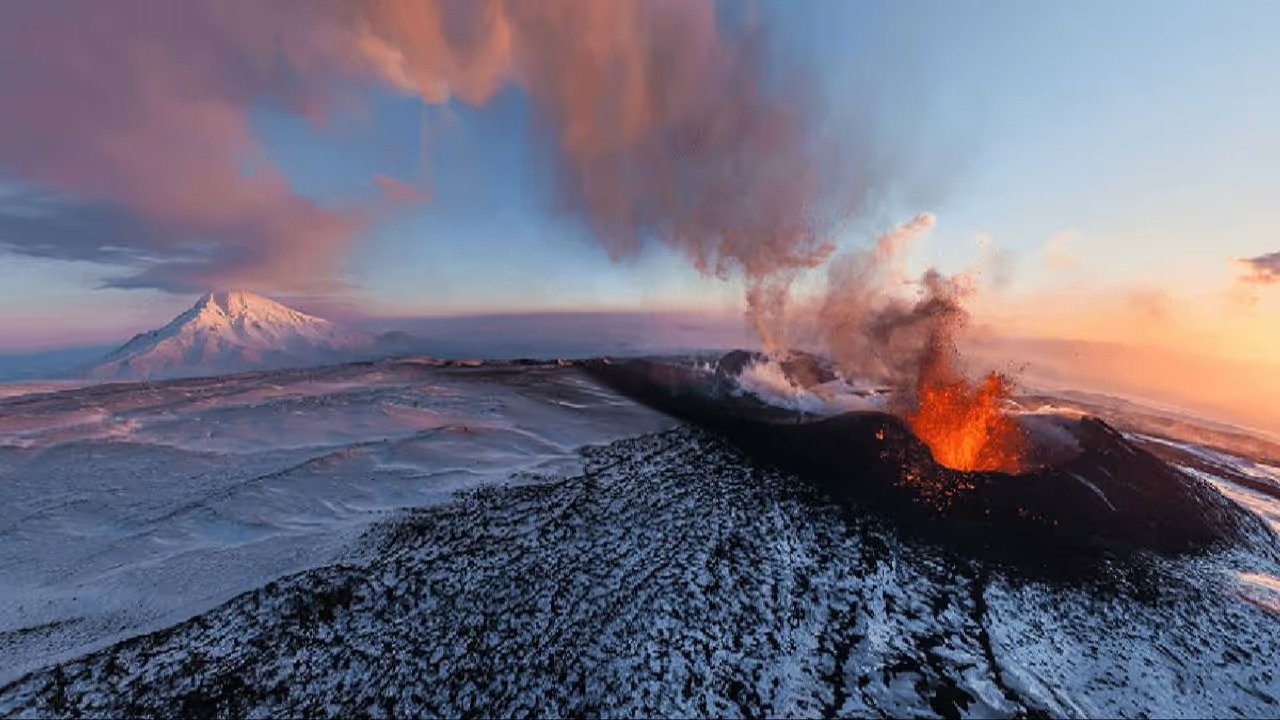


Deep in the icy wilderness of Antarctica stands one of the world’s most extraordinary volcanoes. Mount Erebus, the southernmost active volcano on Earth, is unlike any other because it continuously releases microscopic crystals of pure gold into the atmosphere.
Scientists estimate that the volcano ejects around 80 grams of gold every day, equivalent to more than Rs 18.9 crore worth of gold annually at current market prices. Yet despite decades of research, exactly how the volcano produces and releases these tiny gold particles remains one of geology’s biggest unsolved mysteries.
The Only Known Volcano That Releases Pure Gold Crystals
Located on Ross Island in the Ross Sea, around 1,350 kilometres from the Geographic South Pole, Mount Erebus is already unique for possessing a permanent lava lake. However, its most remarkable feature is something far rarer.
According to a 1991 study published in Geophysical Research Letters, Mount Erebus is the only volcano in the world known to emit crystalline elemental gold particles into the atmosphere.
Researchers found that the volcano’s lava lake constantly releases volcanic gases containing microscopic gold crystals. At today’s gold prices, the volcano emits gold worth approximately $6,000 (around Rs 5.66 lakh) every day.
Over the course of a year, that amounts to more than $2 million, or roughly Rs 18.9 crore.
Gold Travels Up To 1,000 Kilometres Across Antarctica
Scientists discovered that the microscopic gold particles are carried high into the atmosphere by volcanic gases before eventually settling onto Antarctic ice.
These particles can travel distances of up to 1,000 kilometres from the volcano before falling back to the surface.
Using powerful electron microscopes, researchers confirmed that the particles were not ordinary dust. Instead, they were well-formed crystals of pure gold, with some measuring up to 60 micrometres in diameter.
The finding remains one of the most unusual discoveries ever made in volcanology.
How Does The Volcano Release Gold?
Finding traces of gold in volcanic emissions is not entirely unprecedented.
Scientists have previously detected small quantities of gold in gases emitted by several volcanoes around the world, including:
- Kīlauea in Hawaii
- Mount Etna in Italy
- Augustine Volcano in Alaska
- El Chichón in Mexico
Researchers believe that gold is transported upward through extremely hot volcanic gases, where it becomes attached to compounds rich in chlorine or sulphur.
As the gases cool, the gold separates from these compounds and crystallises.
However, Mount Erebus behaves differently from every other known volcano.
Scientists Still Don’t Know Exactly How It Happens
More than three decades after the discovery, researchers are still trying to understand the precise mechanism behind Mount Erebus’ gold emissions.
Scientists have proposed two leading theories.
Theory One: Gold Forms Directly In Volcanic Gases
One possibility is that the gold crystallises directly from chlorine-rich volcanic gases as they cool after leaving the volcano.
However, researchers believe this explanation has limitations because the gases themselves contain only very small concentrations of gold.
Theory Two: Gold Forms Inside The Lava Lake
Another hypothesis suggests that the gold crystals develop gradually on the surface of Mount Erebus’ permanent lava lake.
Once formed, these microscopic crystals may then be carried into the atmosphere by escaping volcanic gases.
Despite years of research, neither theory has been conclusively proven.
One Of Antarctica’s Greatest Geological Mysteries
Mount Erebus continues to fascinate volcanologists because it combines several unique geological characteristics in a single volcano—a persistent lava lake, continuous gas emissions and the only confirmed release of microscopic crystalline gold.
More than 30 years after scientists first documented the phenomenon, the exact process responsible for producing and ejecting the tiny gold crystals remains unknown, making Mount Erebus one of Earth’s most intriguing natural mysteries.