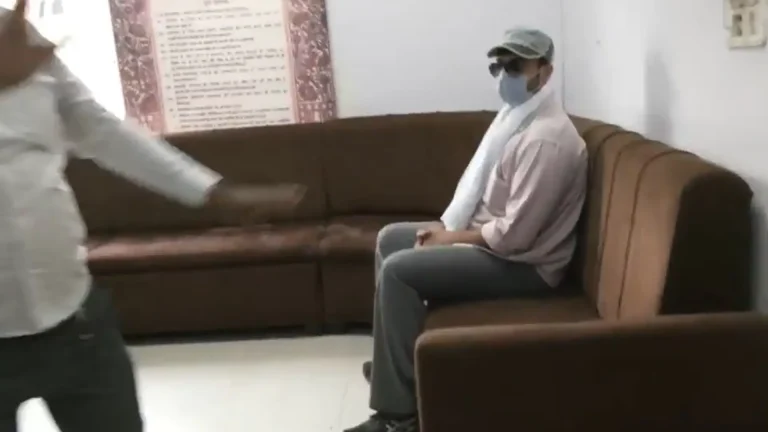
Bhopal: In a major development in the alleged dowry death case of 33-year-old Twisha Sharma, her husband Samarth Singh has been arrested after remaining untraceable for nearly 10 days following her death at their home in Bhopal.
Samarth Singh, a lawyer by profession, was taken into custody after appearing at a court in Jabalpur to surrender. His appearance came shortly after he withdrew his anticipatory bail plea from the Madhya Pradesh High Court.
According to reports, the Jabalpur court directed him to surrender before a Bhopal court. However, a police team already present at the court premises detained him immediately and later transported him to Bhopal for further investigation.
Witnesses said Samarth Singh attempted to conceal his identity while entering the court complex. He reportedly wore a mask, sunglasses, a cap and wrapped a cloth around his shoulder, covering most of his face.
Twisha Sharma Was Found Hanging At Her Bhopal Home
Twisha Sharma was found hanging at her residence in Bhopal’s Katara Hills area on May 12. While the case was initially treated as a suicide, allegations from her family soon intensified the matter into an alleged dowry harassment and abetment case.
Her family accused Samarth Singh and his mother, retired judge Giribala Singh, of mentally harassing Twisha over dowry demands and humiliating her repeatedly after marriage.
The family also expressed dissatisfaction with the police investigation and refused to accept custody of Twisha’s body initially. They demanded a second post-mortem examination, alleging discrepancies in the first autopsy report.
According to family members, Twisha had repeatedly shared with relatives and friends that she felt trapped in an unhappy marriage and was under constant emotional distress.
Mother-In-Law’s Remarks Spark Outrage
The controversy deepened further after Giribala Singh publicly made several remarks about her late daughter-in-law. She allegedly claimed Twisha was suffering from depression and accused her of consuming narcotics.
In multiple statements, Giribala Singh questioned Twisha’s character and intentions, comments that triggered outrage on social media and among women’s rights groups.
Speaking to NDTV, Twisha’s brother, Major Harshit Sharma, described the situation as “unfathomable” and questioned how his sister could continue living in what he called a “suffocating house”.
“How can a woman who wanted to have a child be questioned about the legitimacy of that child and her character by both her husband and mother-in-law?” he said.
He also accused Giribala Singh of attempting to interfere with the investigation.
High Court Orders Second Post-Mortem
In another major development, the Madhya Pradesh High Court on Friday permitted a second post-mortem examination of Twisha Sharma’s body.
The court directed that the autopsy be conducted in Bhopal by a medical team from AIIMS Delhi. Twisha’s family had alleged that the first post-mortem report failed to properly document injuries found on her body.
Questions were also raised over discrepancies in official records, including differences in Twisha’s height mentioned in the police report and the autopsy findings.
Police Seek Cancellation Of Giribala Singh’s Bail
Meanwhile, the Madhya Pradesh Police has also approached the High Court seeking cancellation of the anticipatory bail granted to Giribala Singh.
Police argued that the sessions court did not adequately consider WhatsApp conversations between Twisha and her parents, which allegedly contained serious accusations against both Samarth Singh and his mother.
Investigators further claimed that Giribala Singh attempted to tamper with evidence and influence the probe, actions they say violate the conditions of anticipatory bail.
The case has now become one of the most closely watched criminal investigations in Madhya Pradesh, with mounting public scrutiny over allegations of dowry harassment, abuse of influence and lapses in the initial investigation.