
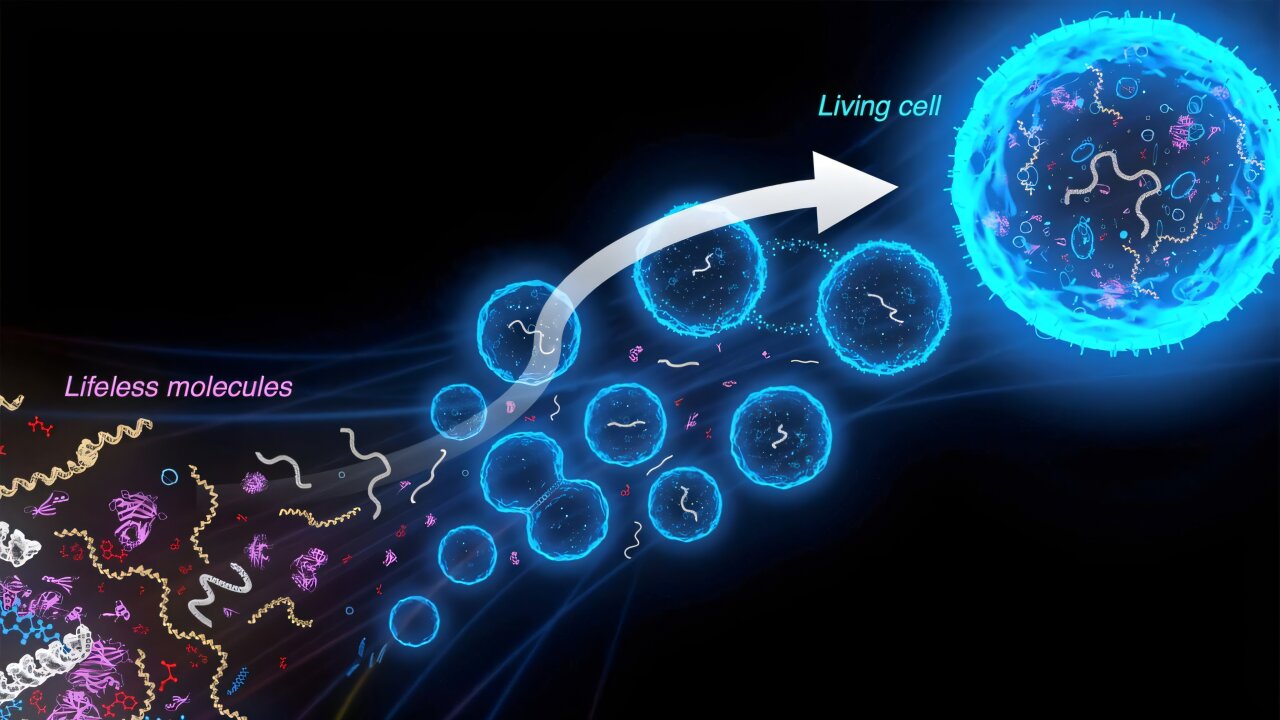


In a monumental milestone for the field of synthetic biology, a research team led by Dr. Kate Adamala at the University of Minnesota has successfully engineered the world’s first synthetic cells constructed entirely from non-living materials that can grow, feed, and divide on their own.
Dubbed “SpudCells,” these laboratory-constructed entities represent the first time science has successfully completed a basic cell cycle—including genetic replication and physical division—using purely artificial chemical building blocks and lab-made DNA.
What Are “SpudCells” and How Do They Function?
SpudCells are microscopic, water-filled bubbles called liposomes, measuring only a few thousandths of a millimeter in diameter.
- The Growth Mechanism: Unlike natural biological cells, SpudCells lack the inherent machinery to manufacture all of their necessary nutrients internally. Instead, they “feed” by fusing with specialized, microscopic feeder particles inside a controlled liquid medium dense with synthetic nutrients and energy molecules.
- Replication and Division: As they absorb these external resources, the artificial cells grow in volume, copy their internal lab-made DNA, and eventually divide by pushing out new “daughter cells.” While researchers note the division process is slower and less refined than natural cellular mitosis, it successfully demonstrates the baseline mechanics of biological life.
Clinical and Environmental Breakthroughs
Medical experts across the globe have hailed this discovery as one of the most critical leaps in bio-engineering in recent history. Because these cells are built fundamentally from the ground up, they offer a far safer, more predictable, and controllable framework than modifying pre-existing bacteria or living organisms.
Future practical applications for this technology include:
- Targeted Drug Delivery: Programming synthetic cells to travel through the human body to deliver targeted molecular therapies or combat localized diseases without impacting healthy tissue.
- Biomedical Manufacturing: Operating as microscopic factories to synthesize complex medications, such as insulin, with unprecedented chemical efficiency.
- Environmental Remediation: Engineering bespoke cells optimized to consume and neutralize toxic industrial pollution or manufacture high-yield sustainable biofuels.
Current Limitations and Next Steps
Despite the breakthrough, researchers emphasize that SpudCells are not yet “fully alive” in a traditional sense. They are exceptionally fragile, require rigidly sustained laboratory conditions to prevent collapse, and currently die out naturally after a few generations. Dr. Adamala’s team describes the current iteration as a biological “chassis”—a fundamental structural framework upon which increasingly complex and resilient synthetic systems can be built.