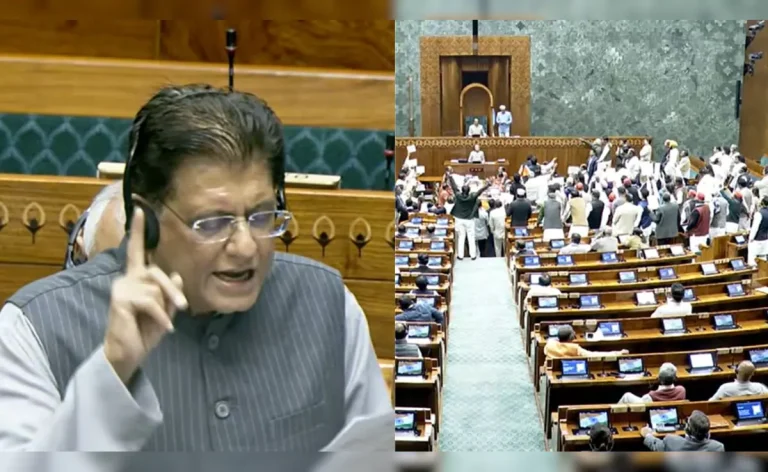
The three-day special session of Parliament is focused on a monumental restructuring of India’s legislative framework. While the Women’s Reservation Bill (Nari Shakti Vandan Adhiniyam) is the headline, the government has introduced three interconnected bills that serve as the “gears” to make the reservation functional.
Here is a breakdown of the three bills and why they are being debated as a single package.
1. The Constitutional Amendment Bill (Expansion)
This is the foundational piece. Rather than redistributing the existing 543 seats—which would lead to a “zero-sum game” where some states lose power to others—the government is expanding the entire House.
- The Goal: Increase Lok Sabha strength to 850 seats (815 for States, 35 for UTs).
- The Logic: Expanding the “pie” allows for the 273 seats required for women’s reservation to be carved out without displacing a massive number of sitting male representatives, thereby reducing political friction.
2. Amendments to Union Territory Laws
This bill focuses on the specific legal frameworks of regions like Delhi, Jammu & Kashmir, and Puducherry.
- The Goal: Align the legislative assemblies of UTs with the new national restructuring.
- The Logic: Delimitation cannot be selective. To implement a 33% quota nationwide, the electoral maps of UTs must be redrawn and their seat counts adjusted simultaneously with the states.
3. The New Delimitation Act and Commission
This is the operational “engine” that puts the other two bills into practice.
- The Goal: Establish a Delimitation Commission of India to redraw constituency boundaries based on the 2011 Census.
- The Logic: This Commission will decide exactly where the new boundaries fall and which specific constituencies will be reserved for women. Without this act, the expansion and reservation remain purely theoretical.
Why the “Bundled” Approach?
The Women’s Reservation Law passed in 2023 explicitly states that the quota can only be implemented after a delimitation exercise. By debating these three bills together, the government is attempting to:
- Remove Hurdles: Address the population-based representation gap that has been frozen for decades.
- Fast-Track 2029: Ensure that the 33% quota is ready for the next General Election.
- Ensure Proportionality: Balance the seat counts so that states with lower population growth (mainly in the South) do not feel penalized by the expansion.
What’s at Stake?
| If the Bills Pass | If the Bills Fail |
| Lok Sabha grows from 543 to 850 seats. | Status quo: Lok Sabha remains at 543. |
| 33% Women’s Quota implemented by 2029. | Women’s reservation remains stalled indefinitely. |
| State Assemblies are recalibrated for population. | Constituency boundaries remain frozen. |
| Major shift in party strategies and pipelines. | Political strongholds remain unchanged. |
Bottom Line: This session isn’t just about a quota; it is the most significant overhaul of Indian democracy’s structure since the Constitution was adopted.