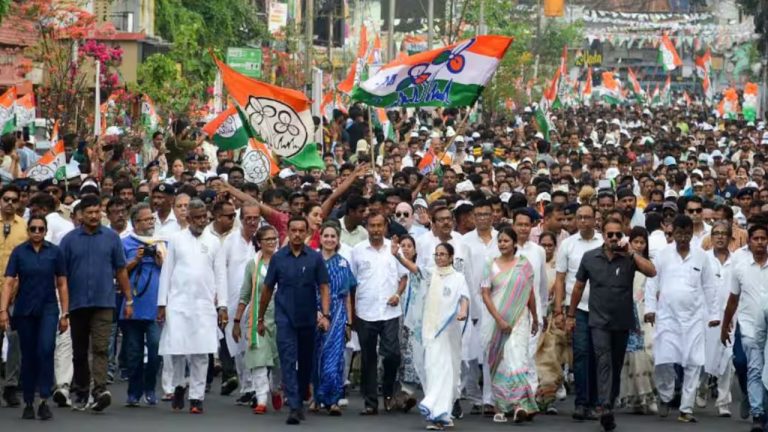
Mamata Banerjee faces a major setback as Bharatiya Janata Party surges ahead, marking a historic political shift in West Bengal.
May 4, 2026: In a dramatic political turnaround, West Bengal appears set to witness a change of power, with the Bharatiya Janata Party leading decisively and ending Mamata Banerjee’s 15-year rule. Known for its legacy of “street politics,” Bengal has historically seen shifts driven by mass movements—from Congress to the Left Front in 1977, and later to the All India Trinamool Congress in 2011. Now, early results suggest another landmark shift, with the same party likely to rule both at the Centre and the state.
Despite an aggressive campaign—where Banerjee addressed around 90 rallies and led multiple roadshows—the TMC struggled against strong anti-incumbency, corruption allegations, and shifting voter dynamics. By evening trends, BJP had surged far ahead, while TMC lagged significantly. Factors such as electoral roll revisions, opposition consolidation, and growing dissatisfaction over unemployment and governance are believed to have played a key role in the outcome.
Banerjee’s political journey—from defeating stalwarts like Somnath Chatterjee in her early years to leading mass movements in Singur and Nandigram—once symbolised grassroots resistance. However, over time, issues like alleged appeasement politics, corruption controversies, and rising polarisation weakened her hold. Welfare schemes that once secured strong support, especially among women, appeared less effective this time, as the BJP’s promise of change resonated widely, marking a significant turning point in Bengal’s political landscape.