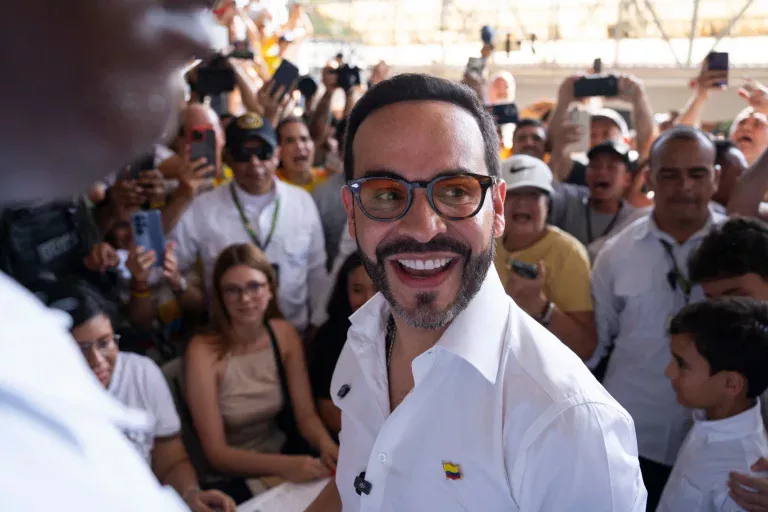
Colombia is heading toward a fiercely contested presidential runoff after conservative outsider Abelardo de la Espriella emerged as the surprise frontrunner in the first round of the 2026 presidential election.
With nearly all votes counted, de la Espriella secured 43.7% of the vote, edging past leftist Senator Iván Cepeda, who garnered 40.9%, according to official election results. The two candidates will now face off in a decisive runoff election scheduled for June 21.
The outcome marked a significant upset, as most pre-election polls had projected Cepeda to finish ahead of de la Espriella. Conservative Senator Paloma Valencia finished a distant third with 6.9% of the vote and quickly threw her support behind de la Espriella, strengthening his position ahead of the second round.
De la Espriella Warns Against Election Challenges
Addressing supporters after the results were announced, de la Espriella delivered a combative speech from Barranquilla, accusing President Gustavo Petro and his political allies of attempting to undermine the election outcome.
Calling on both Colombia’s military and the international community to safeguard the democratic process, de la Espriella claimed there were efforts to challenge the will of voters.
“Turn your attention to Colombia,” he said. “Petro, the coup plotter, as he has warned, intends to cling to power by disregarding the will of the people.”
The conservative candidate also appealed to the United States to oversee the upcoming runoff election, underscoring the growing tensions surrounding the race.
Petro And Cepeda Raise Concerns Over Vote Count
President Gustavo Petro, Colombia’s first leftist president, responded cautiously to the preliminary results. In a post on social media platform X, Petro stated that he would wait for the official scrutiny process to be completed before recognizing the final outcome.
Cepeda echoed similar concerns, saying he would accept the results only after authorities review what he described as voting irregularities.
The leftist candidate also accused Ecuadorian President Daniel Noboa of interfering in Colombia’s election after Ecuador removed tariffs on Colombian goods shortly after Noboa reportedly spoke with de la Espriella.
“With effort and imagination, we have achieved a vote as significant as the one we have today, albeit poorly counted,” Cepeda told supporters in Bogotá.
Record Voter Turnout Signals High Stakes
The election witnessed unprecedented public participation, with voter turnout reaching approximately 58%, the highest ever recorded in a first-round Colombian presidential election.
The strong turnout reflects the deep divisions shaping Colombian politics, as voters choose between two candidates representing sharply different visions for the country’s future.
Markets And Investors Welcome Result
Financial markets are expected to respond positively to de la Espriella’s strong performance.
Many investors have expressed concerns about the possibility of another leftist administration extending Petro’s economic policies, which critics argue could increase public debt and weaken the independence of Colombia’s central bank.
In the week leading up to the election, Colombian assets benefited from growing confidence in de la Espriella’s prospects. Dollar-denominated bonds delivered gains of nearly 2%, while yields on peso-denominated debt declined.
Prediction markets also heavily favor de la Espriella heading into the runoff. According to Polymarket, he currently holds an 81% chance of winning the presidency, compared to 18% for Cepeda.
Sharp Contrast In Policies
The runoff will present voters with two starkly different policy agendas.
De la Espriella has pledged to strengthen ties with US President Donald Trump, reduce government spending, lower taxes, and intensify military operations against cocaine-trafficking groups and armed militias operating across Colombia.
Cepeda, meanwhile, advocates greater social spending, continued negotiations with armed groups, and a more independent foreign policy that is skeptical of US involvement in Latin America.
Election Highlights Deep Political Divisions
Supporters of de la Espriella turned Colombia’s national football jersey into a symbol of his campaign, with many voters arriving at polling stations wearing the country’s iconic yellow colors.
Although de la Espriella dominated nationally, Cepeda performed strongly in Bogotá, where he secured nearly 42% of the vote compared to de la Espriella’s 38%.
Political analysts believe the runoff will largely depend on whether de la Espriella can consolidate support from Valencia’s voters while appealing to moderate centrists.
“The momentum is with De la Espriella,” said Sergio Guzmán, director of Colombia Risk Analysis. “He pulled off a major upset despite never having held elected office before and lacking the support of traditional political machines. He has an advantage, but he needs to manage it carefully. The runoff is going to be extremely close.”
Blow To Traditional Conservatives
The results also represent a setback for Colombia’s traditional conservative establishment.
Valencia’s failure to secure even 10% of the vote highlights the decline of Uribismo, the political movement led by former president Álvaro Uribe that dominated Colombian politics for nearly two decades before Petro’s election in 2022.
Despite recent tensions between Valencia and de la Espriella during the campaign, her endorsement—along with backing from Uribe—is expected to help unify conservative voters ahead of the runoff.
Political scientist Sandra Borda of Universidad de los Andes believes de la Espriella enters the second round as the favorite.
“The great majority of Paloma Valencia’s voters will likely support him,” she said. “Some centrist voters are uncomfortable with De la Espriella and may move toward Cepeda, but at this point it still appears difficult for Cepeda to overcome the gap.”
Part Of A Wider Latin American Trend
Colombia’s election is unfolding against a backdrop of growing political polarization across Latin America.
In Peru, voters are preparing for a runoff between conservative candidate Keiko Fujimori and left-wing challenger Roberto Sánchez. Meanwhile, Brazil’s President Luiz Inácio Lula da Silva is facing increasing pressure from a conservative movement led by Senator Flávio Bolsonaro, son of former president Jair Bolsonaro.
Argentina’s President Javier Milei was among the first regional leaders to congratulate de la Espriella, praising Colombian voters for what he described as a rejection of socialism.
“The Colombian people have shown their determination to put an end to the failed socialist model that has done so much damage to our region,” Milei wrote on X.